Es
EsThe South Korean government has launched two processes related to its trade in washing machines with the U.S. that seem likely to sour the next round of KORUS trade talks. In the first the Ministry of Trade and Industry has applied to the WTO to apply $711 million in trade sanctions against the U.S. with regards to the latter’s 2013 trade case regarding large residential washing machines.
Panjiva data shows South Korean exports of large residential washing machines fell from a peak of $673 million in the 12 months to October 2010 to a trough of $80 million as at July 2016. They have since recovered, likely as manufacturers seek to build inventories ahead of the January 23 2018 tariff decision.
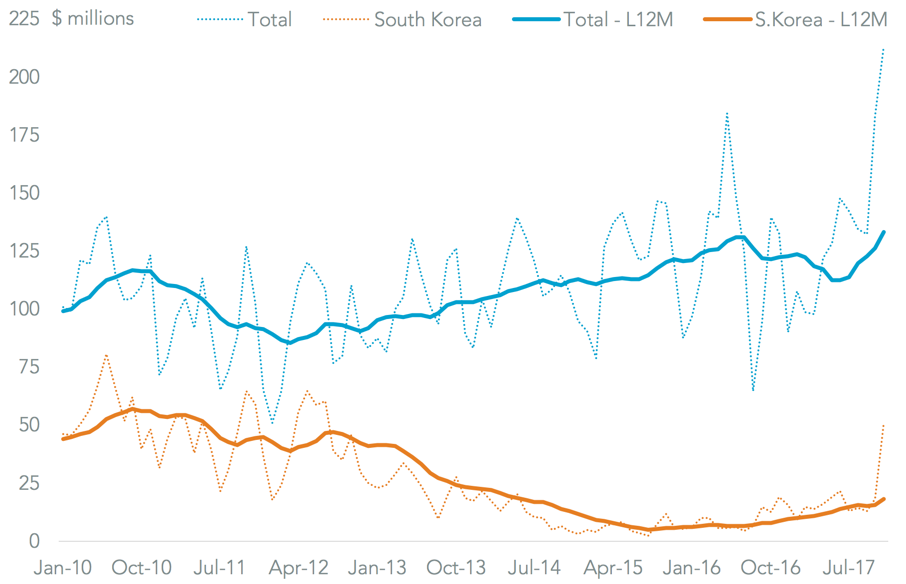
Source: Panjiva
The WTO gave the U.S. until December 2017 to change its conclusions, as outlined in Panjiva research of September 8 2016. The U.S. declined to do so, allowing South Korea to make the application for remedies – likely in the form of tariffs against other U.S. imports. A similar action may be possible in the recently agreed OCTG steel case.
In the second action the South Korean government also plans to complain about the U.S. section 201 “safeguarding” review process more broadly. That follows the decisions made by President Trump to apply tariffs to both washing machine and solar power equipment imports that will have an impact on South Korean companies. Both actions may simply be negotiating tactics ahead of the next round of KORUS negotiations.
The largest U.S. export lines to South Korea, against which tariffs could be applied, include civilian aerospace ($3.5 billion of annual exports), semiconductors ($2.1 billion), machines for manufacturing semiconductors ($1.9 billion), corn ($870 million) and passenger vehicles ($740 million).
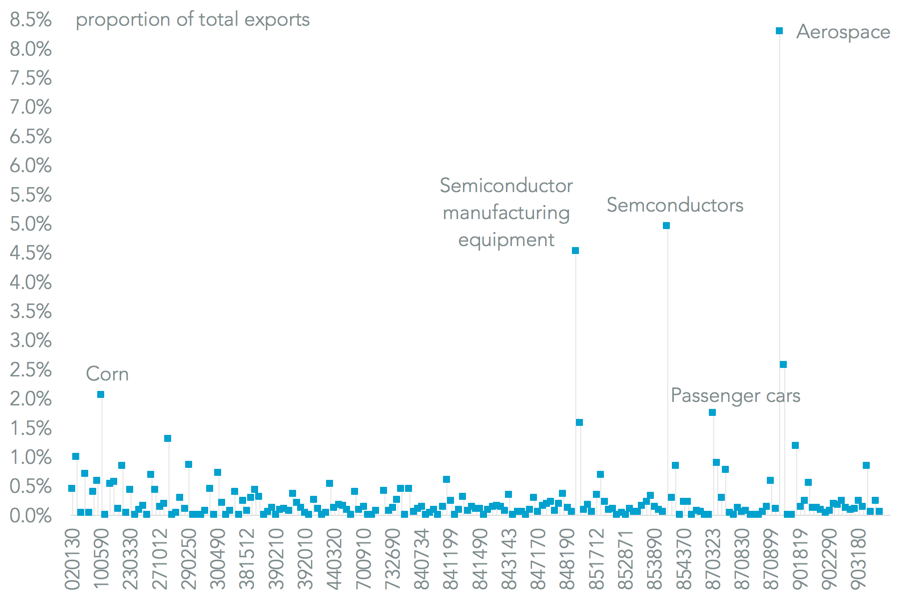
Source: Panjiva