Es
EsU.S. Senate Finance Committee Chair, Chuck Grassley, has stated that a normalization of reduced tariffs of personal protective equipment (PPE) will only be possible in the lame duck (post election) period if attached to a new COVID-19 relief bill or a tax expenditures bill, Inside Trade reports.
The “Stop PPE Taxes Act“, introduced in August, aims to remove both baseline and section 301 duties from PPE imports through to the end of 2022. It’s worth noting that most medical products have already been granted exemptions from section 301 duties on imports from China as flagged in Panjiva’s April 20 report.
While the act would cut the costs of treating COVID-19 it could also undermine attempts by the Trump administration, and proposed policies from the Biden campaign, to onshore medical supply manufacturing. As outlined in Panjiva’s Q4 Outlook there’s likely to be a widening process of medical onshoring support globally as governments seek to improve the resilience of supply chains ahead of future pandemic risks.
The U.S. International Trade Commission has defined a list of what counts as products needed for COVID-19 treatment spread across the categories of protection, diagnostics and treatment. Panjiva’s analysis, updated for recent changes to the U.S. tariff code, shows that 78.1% of the $129.2 billion of medical supply imports were already free of duties in the 12 months to Aug. 31.
Shipments of non-dutiable products have seen a more robust development in the past three months than those subject to tariffs including a 17.3% sequential rise in August compared to a 12.8% decline for all dutiable products. A similar pattern was seen in June and July.

Source: Panjiva
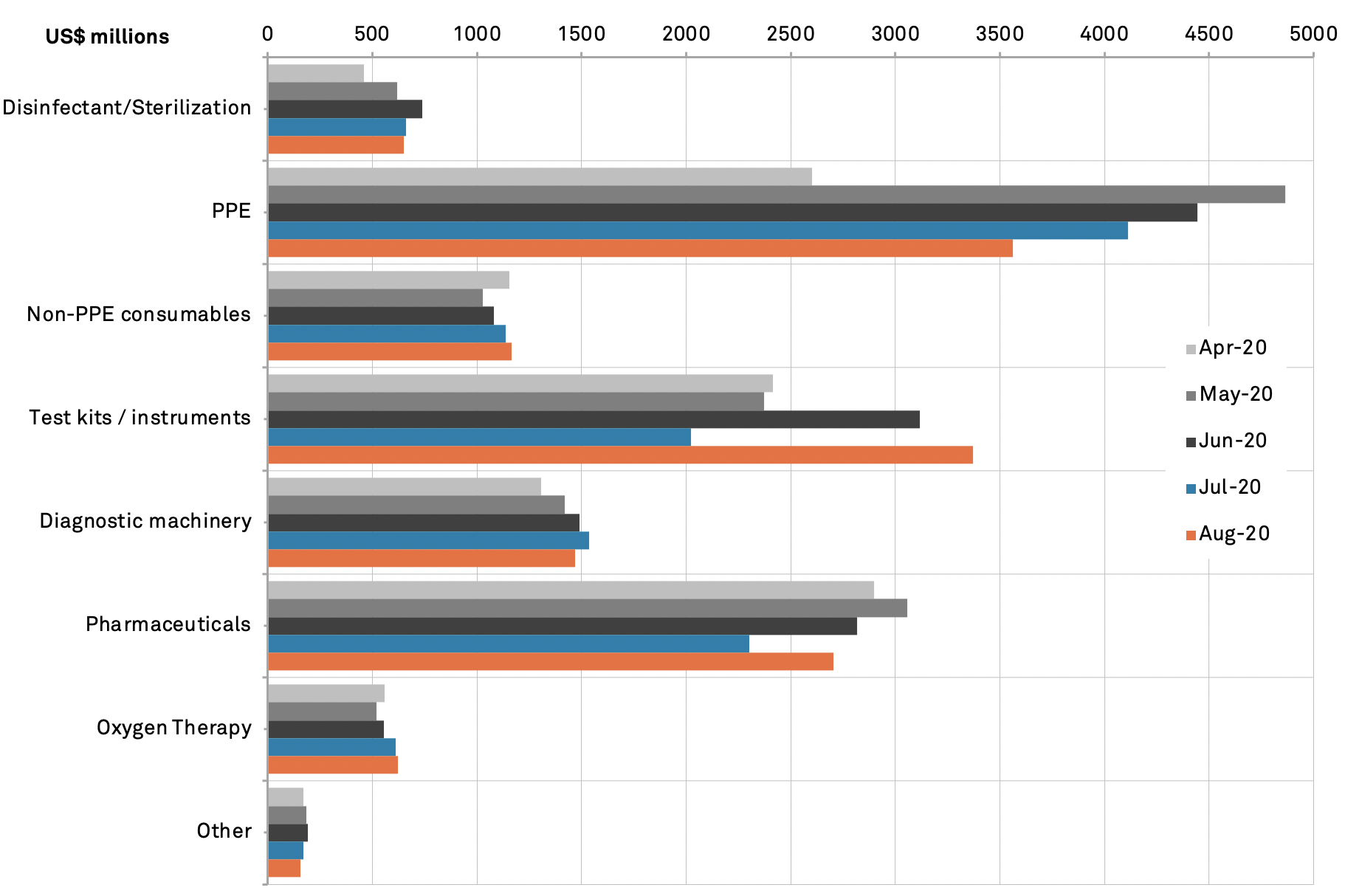
U.S. imports of PPE are proving particularly sensitive, having fallen sequentially for three months with a 13.4% drop in August compared to July while shipments of sterilization products declined by just 1.7% and non-PPE consumables rose by 2.5%. Elsewhere in the treatment chain there was a recovery in test kit imports with a 66.7% rise while imports of pharmaceuticals recovered by 17.4% after two sequential declines.
Source: Panjiva
The drop in PPE imports took imports in August to $3.56 billion, the lowest level since April. Seaborne import data meanwhile shows that there’s likely been another step down in September with a 13.6% sequential drop in imports of face masks on a daily average basis coming alongside a 6.1% slip in gloves and a 6.4% decline in shipments of surgical drapes.
Other medical supplies may be picking up however, with the key distribution firms seeing an increase in shipments in August and September.
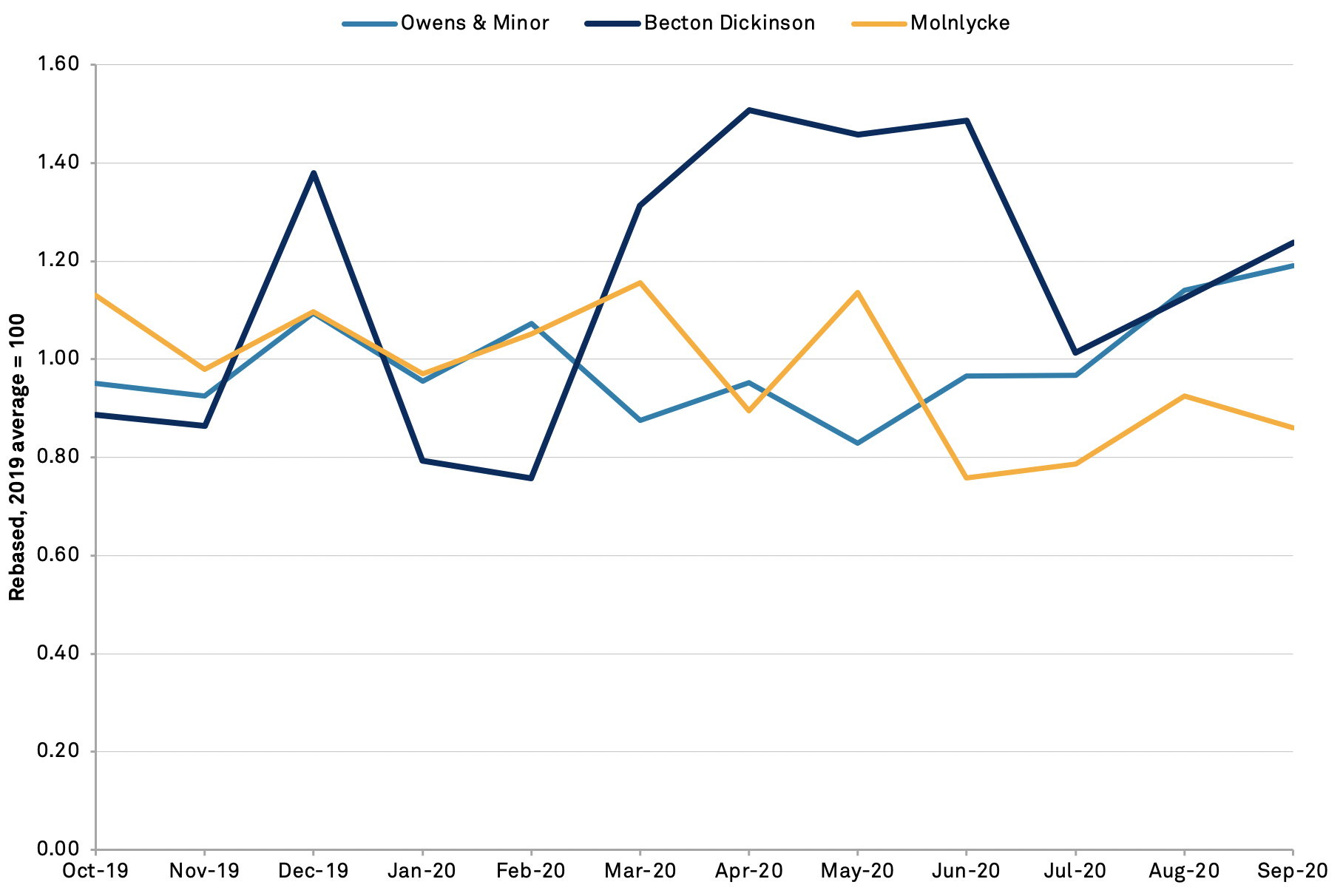
Panjiva’s analysis shows that U.S. seaborne imports linked to Owens & Minor and Becton Dickinson have picked up with improvements of 4.4% and 10.0% in September versus August. Shipments linked to Molnlycke meanwhile dipped by 7.0% in September but are still well above June’s trough.
Source: Panjiva