Es
EsWe held a Panjiva Discussions webinar on December 12 to discuss the background, progress so far, key issues and outlook for NAFTA negotiations. The speakers were Panjiva’s research analyst, Chris Rogers, and Caitlin Webber of Bloomberg Intelligence. The key points and slides covered in the presentation section of the call can be found in Panjiva research of December 7, but you can follow the webinar recording below. Our responses to the questions asked are documented below.
Q: How will the changes, including taxes, affect different modes of transportation?
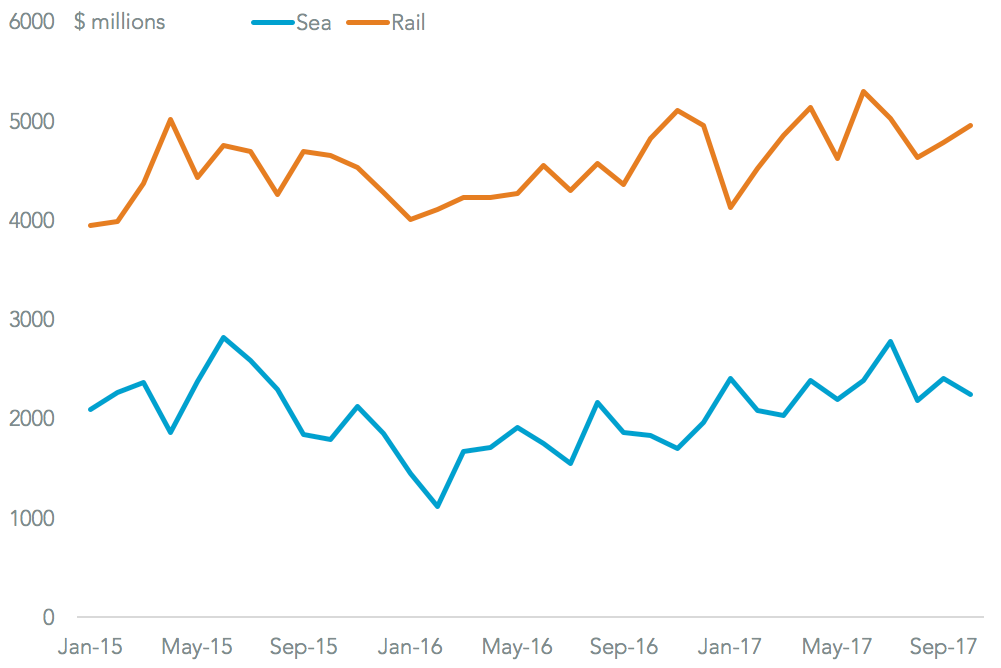
The short answer: Tax reform complicates the NAFTA process in the form of the new 20% excise duty on U.S. corporates’ imports of parts from their subsidiaries. That may make on- or near-shoring more attractive, favoring rail and truck (from Canada, Mexico or domestically) over ocean freight.
Tax policy doesn’t operate in isolation, and the current U.S. tax reform process will add a layer of complication to whatever emerges from the NAFTA discussions. Of particular relevance is the proposed excise duties. These will require U.S. companies to pay a 20% tax on the value of imports from their overseas subsidiaries. That’s partly designed to encourage “onshoring” of component manufacturing, and could catch Mexican and Canadian operations.
One offset would be to “near shore” – namely cut logistics costs by moving production to Mexico from further afield) which might help rail and trucking at the expense of ocean-freight. Panjiva data shows 7.5% of Mexican shipments exports to the U.S. and Canada currently move by sea vs. 16.3% for rail.
Source: Panjiva
Q: What (if any) anti-dumping decisions have been made, what industries might they impact and what might change?
The short answer: U.S. AD/CV decisions on jets and softwood lumber have pushed Canada into a more hawkish position. National protocols aren’t likely to change after the deal, but there will be a new dispute settlement process.
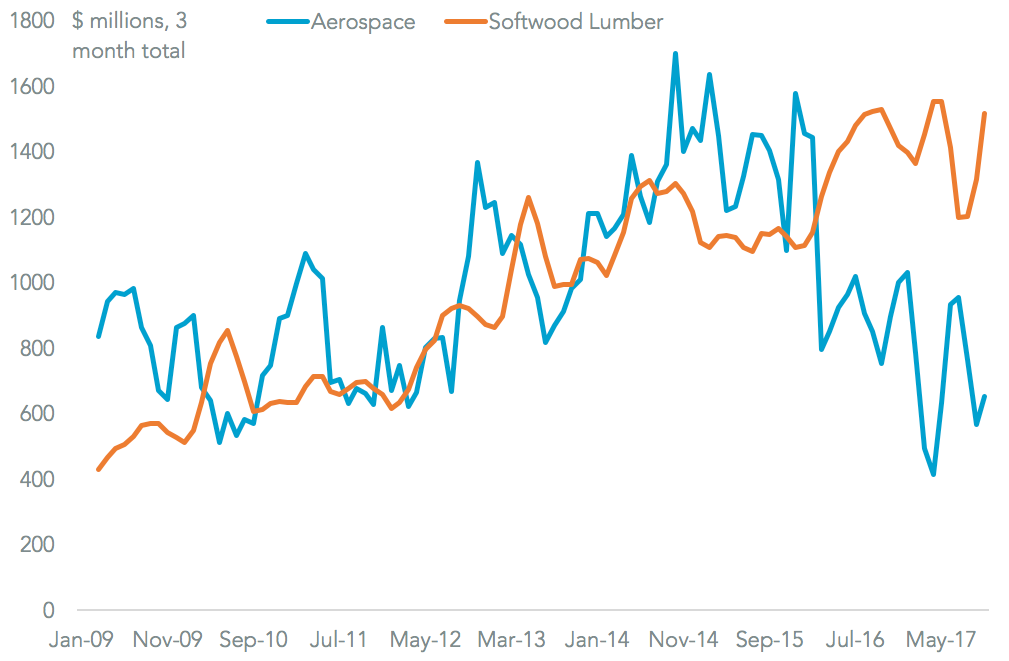
There’s already a well-established set of protocols within each country for handling anti-dumping, and countervailing duty, cases. Some of these have had a significant effect on relations between Canada and the U.S. after the latter applied duties to the former’s exports of softwood lumber and passenger jets. That has arguably brought Canada to a more hawkish stance, as shown by the clear statement of five red line areas.
The national-level protocols may not change, but the dispute settlement mechanisms enshrined in Chapter 19 of the existing NAFTA rules may do so. Canada has already taken the softwood lumber decision to both the NAFTA and WTO panels. It will likely be resistant to U.S. attempts to soften or remove the panel’s powers. For reference U.S. imports of aerospace products have fallen 13.3% in the three months to October 31 on a year earlier while imports of softwood lumber are unchanged.
Source: Panjiva
Q: We’re getting ready to get some product made in Mexico. Are there any foreseeable NAFTA issues we should be aware of moving forward?
The short answer: NAFTA can change everything – check risk sharing in existing supply contracts and the rate of WTO MFN tariffs for your products in the event NAFTA is cancelled.
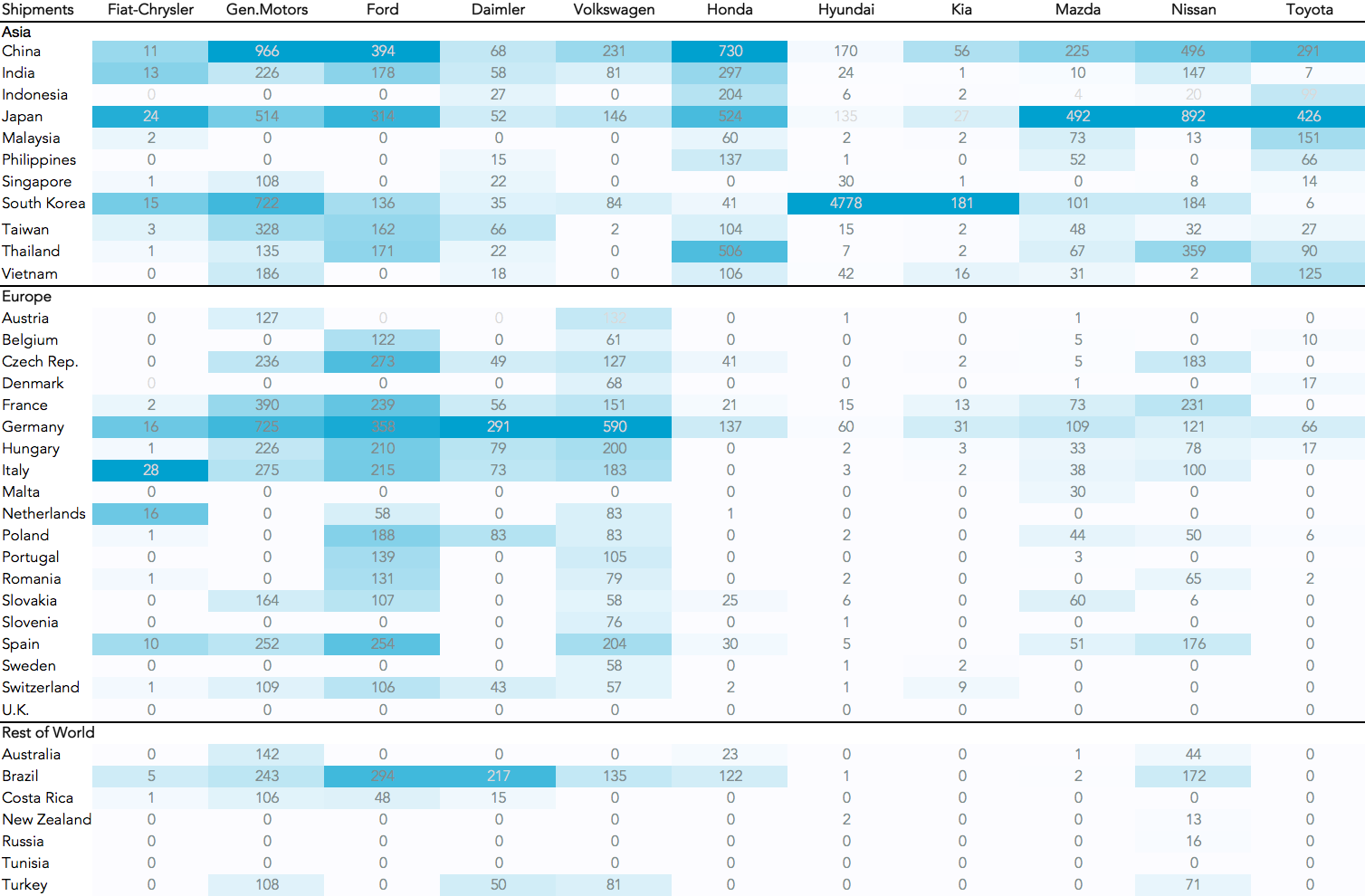
NAFTA can potentially change everything about a company’s supply chain operating environment, particularly in relation to rules-of-origin – whether in the automotive sector or otherwise. As an example the big 11 importers of auto-parts into Mexico have fundamentally different global sourcing strategies that could be shaken up by the increased rule-of-origin requirements as well as U.S.-specific elements.
Should NAFTA be terminated (see more below) then tariffs and non-tariff barriers are likely to rise. The starting point is to review the contractual backing of supply chains, particularly in relation to risk sharing though individual legal advice is a must. Another precaution is to review the WTO’s most-favored nation clause tariff rates. Presumably these would come into force if NAFTA is terminated.
Source: Panjiva
Q: Would the U.S.-Canada FTA that predated NAFTA come into effect if current talks implode? What about the U.S. WTO position?
The short answer: Not necessarily, though Canada has indicated a willingness to negotiate a bilateral deal with the U.S. More likely is the application of WTO rules, which the U.S. is likely to remain in as long as some reforms are agreed.
While the free trade agreement between the two countries was previously in place, that doesn’t mean the two would “drop back” to that deal. From a practical perspective it is quite out of date, though Prime Minister Justin Trudeau has indicated a willingness to review it if NAFTA comes to an end, Bloomberg reports. Were that to occur the political process followed in negotiating NAFTA, including Trade Promotion Authority in the U.S., would need to be re-run. More likely the three countries would revert to their WTO trading relationships.
The U.S. does not, at this stage, appear to be of a mind to leave the WTO on the basis of comments made by U.S. Trade Representative Robert Lighthizer at this week’s WTO ministerial conference. That doesn’t mean, of course, that it would not in the future if some sort of reform at the WTO isn’t enacted.
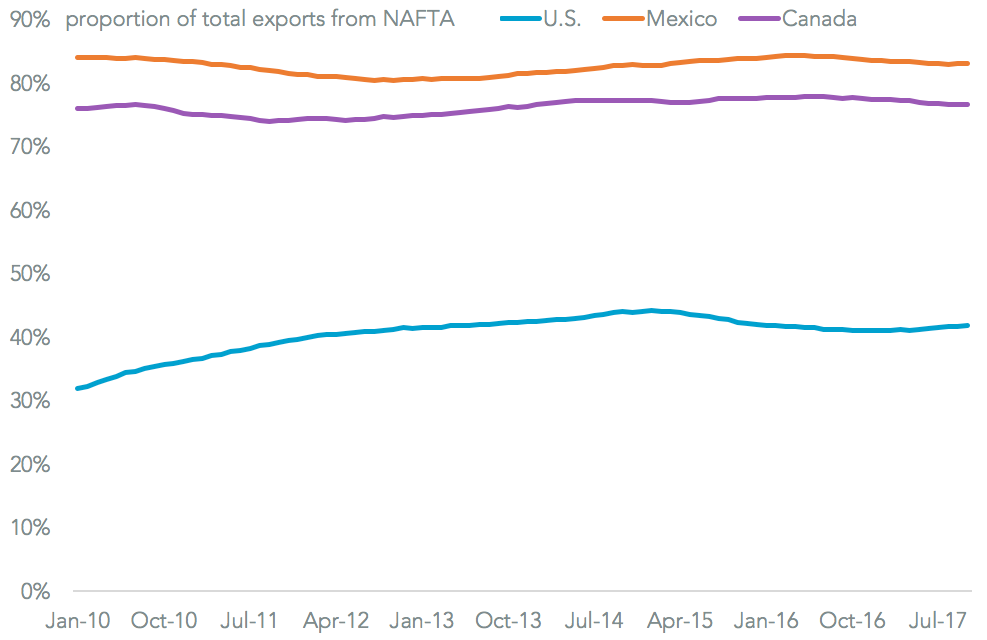
In the meantime the three countries have a vested interest in maintaining NAFTA’s integrity. The bloc accounts for 83.2% of Mexico’s exports, 76.7% of Canada’s and 41.9% of the United States’ in the 12 months to October 31.
Source: Panjiva
Q: Will Trump quit NAFTA? What positions / power does Congress have regarding NAFTA?
The short answer:If progress isn’t made in January the President may well give the order to quit NAFTA. That doesn’t mean it leaves straight away (there’s a six month holding period). Congress needs to be consulted as NAFTA is enacted in legislation (and would need repealing), and also has control over the TPA process the President needs for other trade deals.
There’s increasing pessimism in Washington DC, both among lobbyists and in Congress, that the President Trump may announce a withdrawal from NAFTA. Success on tax reform may embolden the President to go for further policy “wins” by being bold on trade.
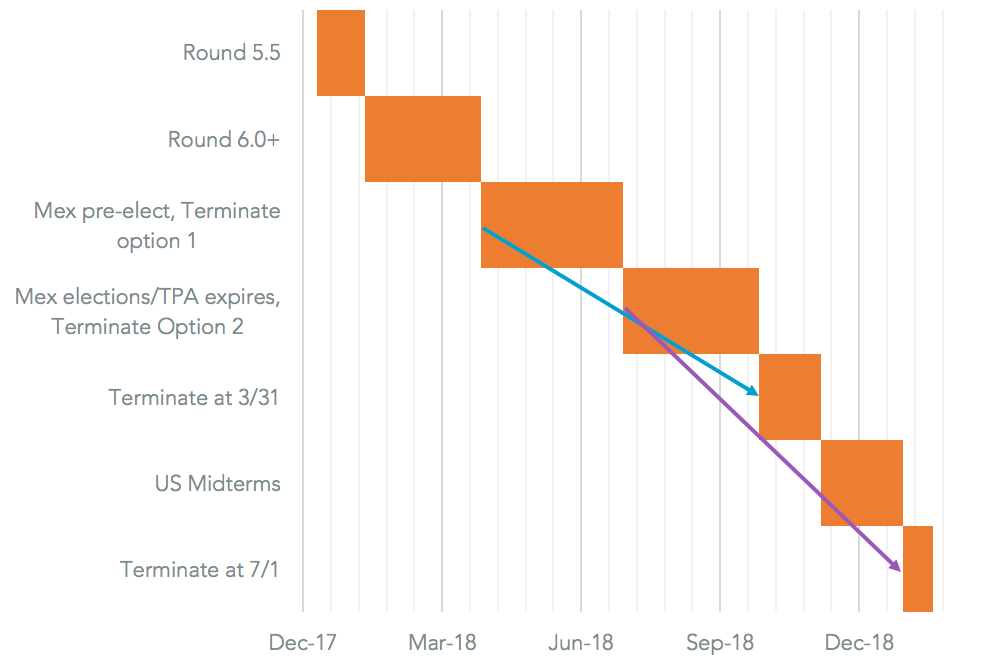
A decision to terminate NAFTA does not mean, however, that the U.S. exits straight away or possibly at all. From a process perspective there is a six month timetable, which the President could utilize to “push” negotiations past the Mexican and U.S. midterm elections should significant progress not be made by late March.
That doesn’t mean the President can act without thought for Congress. NAFTA was approved by Congress and formulated into legislation, which will need Congressional approval to change. There is also a conflict as to whether NAFTA represents foreign policy (under the President’s purview) or is entirely trade policy (enacted by Congress).
It also is likely that the administration will want to get renewed Trade Promotion Authority ahead of it lapsing in July 2018. Without it the President would face all future trade deals being picked over in detail by Congress rather than having a simple “up-down” approval approach. The issue of exiting NAFTA and renewing TPA would likely become intertwined.
Furthermore there would likely be legal challenges to an exit from NAFTA, as there has been with the President’s immigration policies that have only recently been approved by the Supreme Court.
The bottom line is that there is a risk that rather than simply disappearing that we end up with a zombie-NAFTA, and trade policy uncertainty at least through the end of 2018.
Source: Panjiva