Es
EsPresident Donald Trump may shortly issue an Executive Order calling for the U.S. Trade Representative to execute a “comprehensive review of international drug purchasing”, Politico reports. This would focus on the causes of price differentials vs. other countries, and find where trade agreements need to be revised. Intellectual property rights will be a major focus, but this will also play into the administration’s aims to reduce healthcare costs.
At a very high level the average costs of pharmaceuticals that are imported to the U.S. are already falling. Panjiva data for imports of prepared medicines shows the value of imports were unchanged in the six months to April 30 (ie since the elections) whereas the volume of imports increased 23.1%. On a 12 month trailing basis average import costs per unit (ie value divided by volume) fell to 11.3% below their September 2016 highs and 15.6% below their 2010 levels.

Source: Panjiva
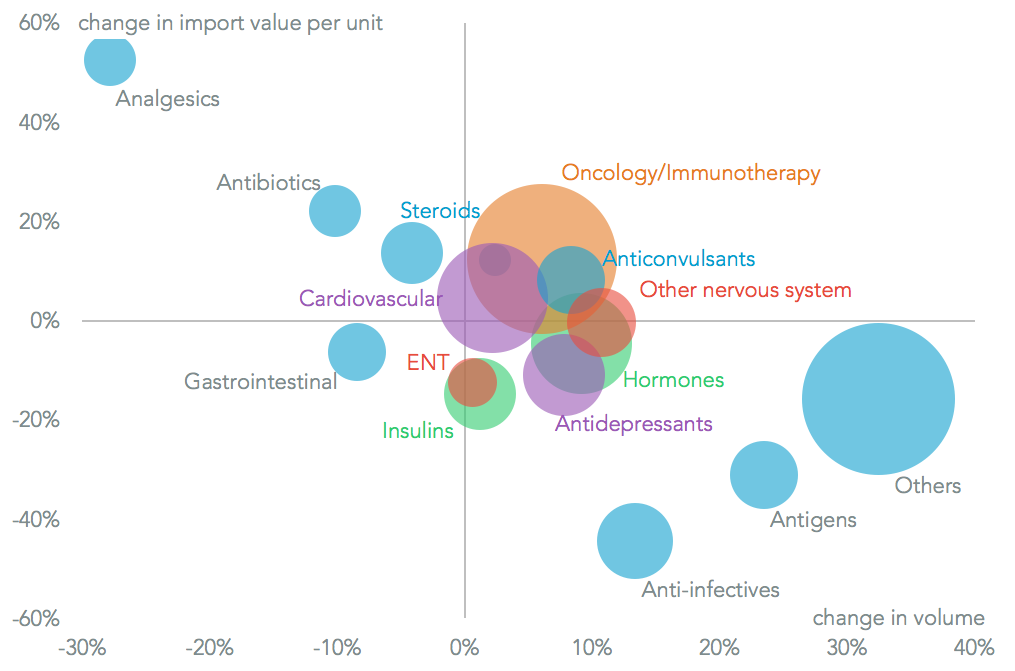
There have been significant differences at the therapeutic level, Panjiva analysis of the top 15 classes shows. Average costs for oncology and immunosuppressive therapies increased 12.4% in the 12 months to April 30 on a year earlier, while volumes imported rose 6.1%. That left the group as the largest component at $13.6 billion of imports in the past 12 months. Cardiovascular treatments also saw a price increase of 4.5%, though volumes only rose 2.2%. Among the larger groups antidepressant therapies’ costs fell 11.0% while insulins dropped 14.8%.
Source: Panjiva
The longer-term decline in average prices reflects drugmakers losing exclusivity to produce their patented drugs, with generic producers then entering the market. The top 12 generic pharmaceutical manufacturers tracked by Panjiva increased their U.S.-bound, seaborne shipments by 6.1% on a year earlier in the three months to May 31. Growth was led by Aurobindo, which expanded 64.0% on a year earlier, alongside Cipla and Zhejiang Huahai which both increased their shipments by over 50%.

Source: Panjiva