Es
EsTwo decisions against U.S. trade case decisions may provide opportunities for President Trump’s administration to act on prior statements on trade sovereignty. The NAFTA dispute panel has ruled against U.S. countervailing duties on Canadian exports of supercalendered paper. It cited the use of the “concurrent subsidies methodology” in relation to certain Canadian regions’ provision of subsidized energy. It requires alternative rates to be proposed by June 27. A removal of NAFTA’s “chapter 19” dispute system is one area that the U.S. wants to renegotiate, according to CBC reports.
Separately a World Trade Organization dispute panel has found that the U.S. must reduce its tariffs on imports of South Korean domestic washing machines by December 26. This follows a ruling that the U.S. did not use “zeroing” methodologies correctly in a case originally decided upon in 2013 that South Korea then appealed. That may clash with a commitment in “The President’s Trade Agenda” reported by the USTR that suggests WTO rulings might not be binding, as outlined in Panjiva research of March 1. Panjiva data shows that U.S. imports of the paper products challenged in the NAFTA case averaged $762.8 million in 2015, the year before the case took effect. They were effectively zero in January and February this year.
In the washing machine case imports from South Korea of the broader category were $123 million in the 12 months to February 28, down from $501 million in 2011. U.S. imports in total had increased since then, however, as a result of increased Chinese shipments. A separate case has been brought against those, leading respondents including Samsung Electronics.
While imports are unlikely to return to previous high levels in both cases, the aggregate swing in shipments relating to the two cases is around $1.14 billion. That gives the administration a significant reason to challenges these disputes.
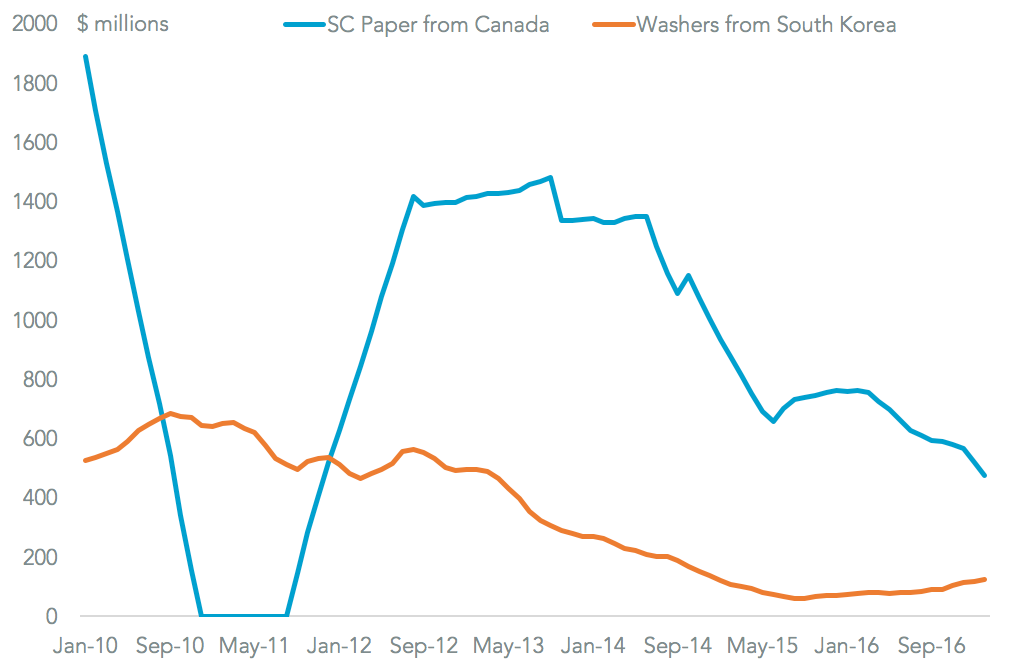
Source: Panjiva