Es
EsPresident Donald Trump referred in his first State of the Union address to America having been subject to “decades of unfair trade deals” and further that he committed his administration to “fix bad trade deals”. The deals referred to were already also meant to be covered by an Executive Order reviewing potential abuses of the terms within trade agreements, as outlined in Panjiva research of January 28.
What is “unfair”, and which trade deals may fall foul of the administration’s determination to fix them?
First, fairness is simply defined as the level – and presumably change in – the merchandise goods deficit based on comments from President Trump reported by the Financial Times (in relation to China) as well as by Commerce Secretary Ross ( CNBC) and Ambassador Robert Lighthizer ( Japan Times).
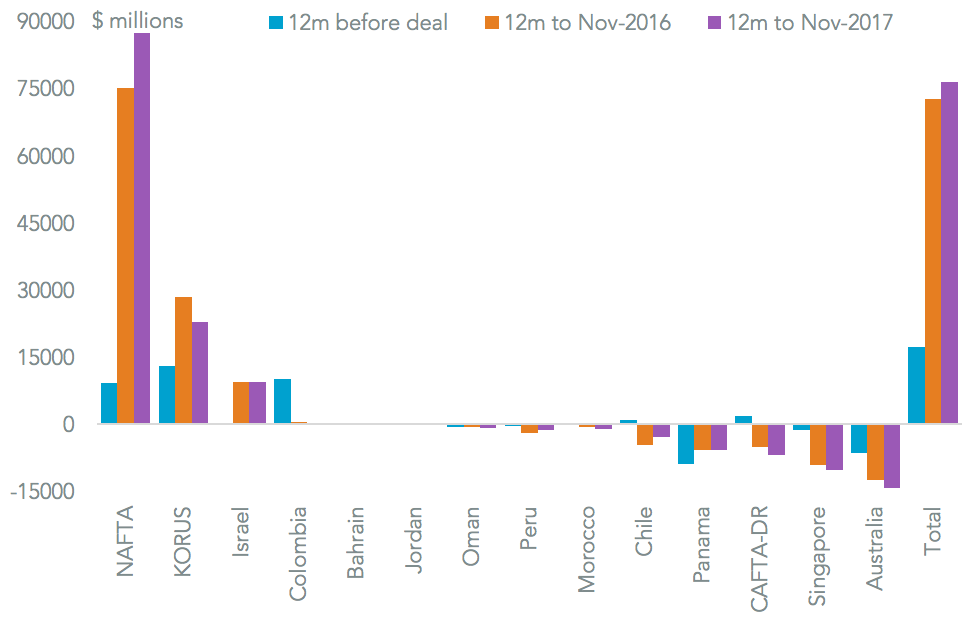
Second, therefore, the trade deals can be judged on whether the U.S. has a trade deficit with the country involved, and whether it has increased vs. the start of the deal. Panjiva data for U.S. merchandise imports and exports shows that, for the 14 trade deals the U.S. is a party too, the total trade deficit in the 12 months to November 30 was $76.5 billion. That compared to $17.3 billion when taking the total for the year before each trade deal started.
Yet, only five deals are actually in a trade deficit position (NAFTA, KORUS, Israel, Colombia and Bahrain). Only three of those – NAFTA with a $87.5 billion deficit, KORUS at $22.9 billion and Israel at $9.46 billion – have seen the deficit increase over time. The other two are experiencing a shrinking surplus, and so are becoming fairer anyway.
The U.S. has a trade surplus with the other nine, though two have seen their surplus shrink (Panama with a $3.14 billion drop since before the FTA was signed) and Jordan ($19 million) so may also be due for review.
Given that NAFTA and KORUS are already under negotiation, presumably the deals with Israel and Panama are therefore of most interest to the administration for a review.
In the case of Israel the deficit is somewhat overstated by $2.4 billion due to trade in diamonds, with much of the remainder relating to pharmaceuticals. That may therefore drop anyway as the Trump administration cuts healthcare costs – also an aim of the State of the Union. Geopolitical issues in terms of the Middle East peace process may also be a concern. Strategic considerations may also apply in the case of Panama, which in some regards has become closer to China in the past year after it derecognized Taiwan.
Source: Panjiva