Es
EsEnergy policy under the administration of President Donald Trump has primarily focussed on traditional sources of energy, as outlined in Panjiva research of April 12, rather than renewables. A delay in a proposed meeting to decide whether to stay in the Paris Climate Agreement, The Guardian reports, adds further uncertainty to clean power policy.
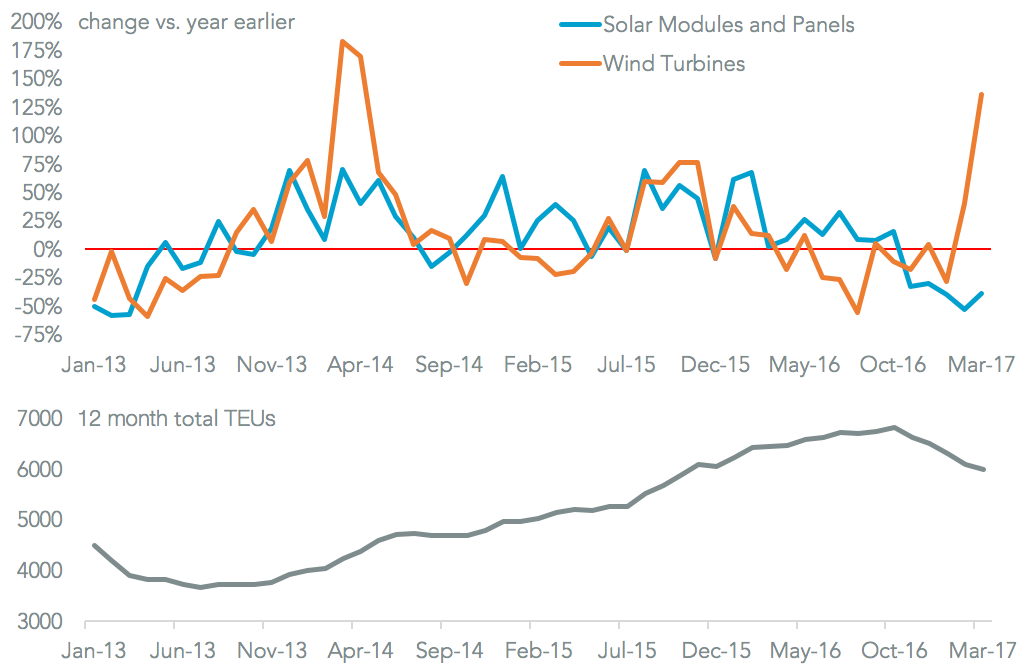
The roll-back of the Clean Power Plan after a recent Executive Order is more about removing pressure on coal than removing supports for renewables. In any event renewable energy projects that would stem from replacing older coal plants wouldn’t have arrived until after 2020. In the meantime support for large scale renewables, including wind, are driven by state-level renewable portfolio standards. Panjiva data shows that wind energy equipment imports reached their highest since at least 2007 in March. The largest importer was Vestas Wind Systems’ nacelle parts business. It accounted for 435 of installed capacity in the U.S. in 2016 according to AWEA data, ahead of domestic manufacturer General Electric.
The picture for solar power equipment was less bright, however, with imports falling 39.2% on a year earlier despite having moved above their multi-year lows in February. As a consequence total imports of renewable energy equipment on an annual basis are still falling.
Source: Panjiva
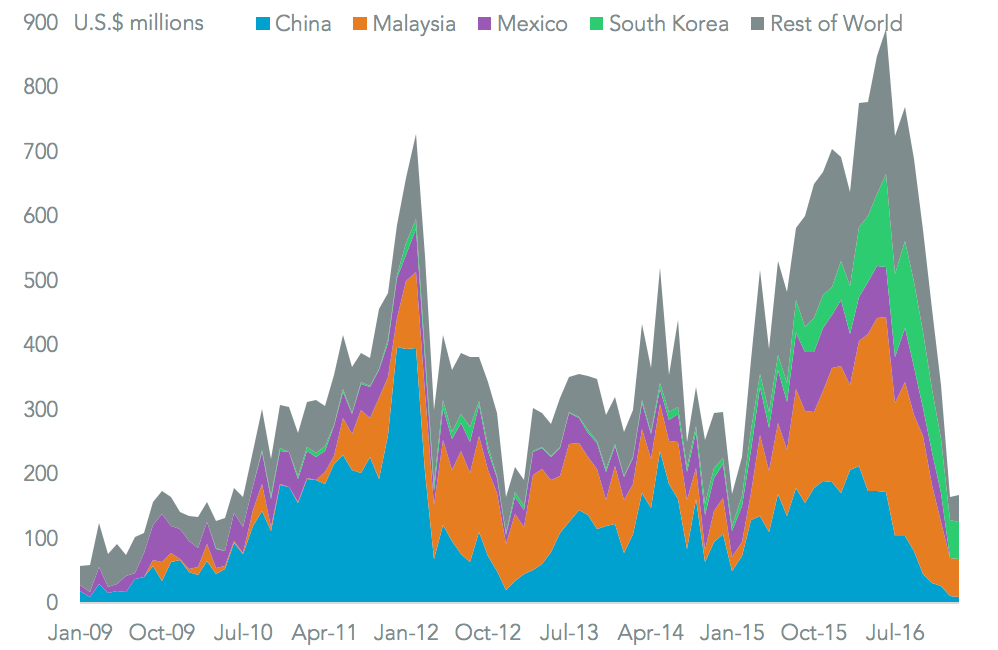
Imports of solar power equipment from China dropped to $8.4 million in February, their lowest since at least 2009. That was partly offset by higher imports from South Korea (11.7% higher in the three months to February 28) and Thailand (15.1% greater over the same period).
Source: Panjiva
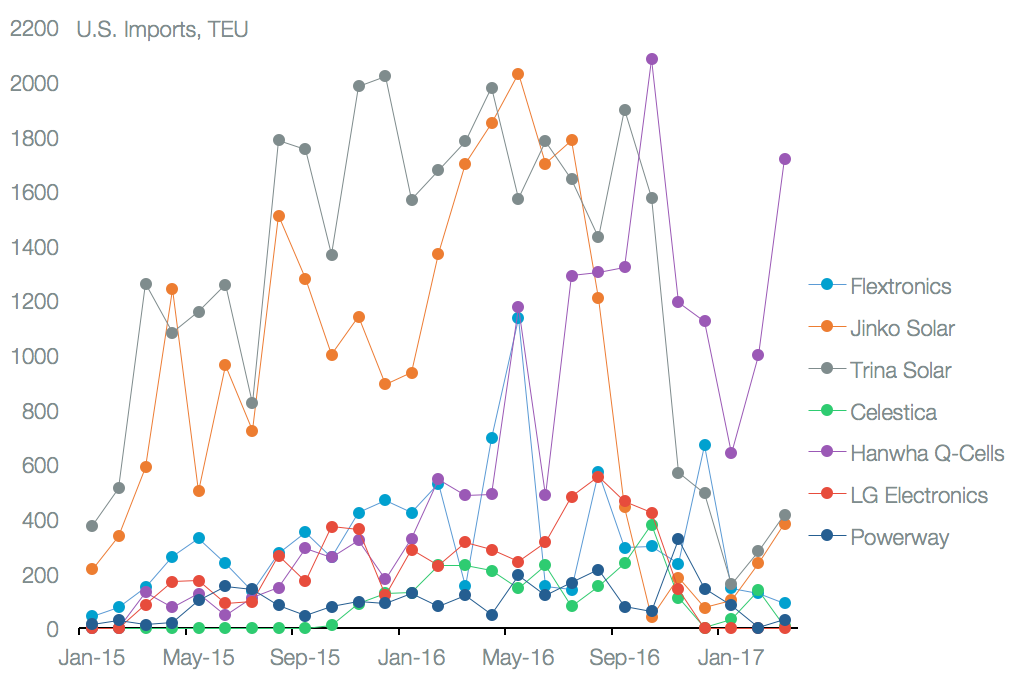
Among the top shippers of solar power equipment to the U.S., Hanwha Q-Cells retained its top place, and has increased its shipments by 147% in the first quarter vs. the same period a year earlier. China-domiciled manufacturers – via their non-Chinese operations – Jinko Solar and Trina Solar were evenly matched in second and third place.
Source: Panjiva
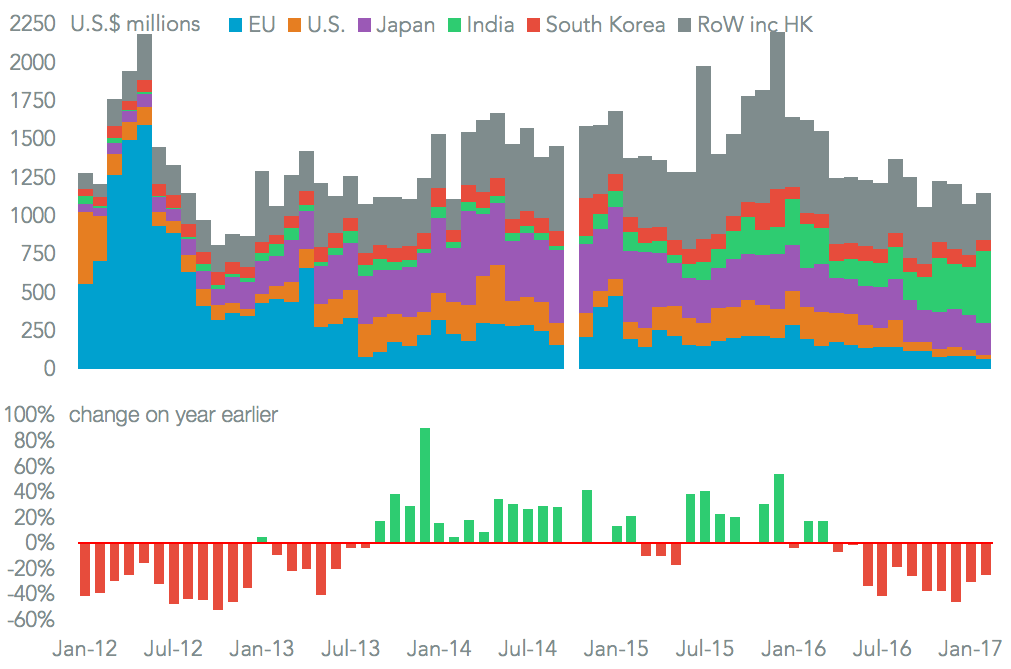
The challenge for producers located in China is that many other regions and countries have enacted tariffs against their equipment. The most recent example was Turkey. There has been significant growth in shipments to India, reaching 63.4% in February, though expansion back into the European Union and as a result of an Environmental Goods Agreement look a long way off.
Source: Panjiva