Es
EsPanjiva Research took part in a webinar on Dec. 8 titled “Politics & Policy – 2021 Insights & Outlooks” where we discussed the prospects for policy in the early months of the Biden administration alongside former Congressmen Eric Cantor (R-VI, now VC of Moelis & Co.) and Joe Crowley (D-NY, now Senior Policy Advisor for Squire Patton Boggs) as well as S&P Global’s Chief Public and Government Affairs Officer Courtney Geduldig. A link to the event’s recording will be available shortly.
A key conclusion from the discussion was that President-elect Biden is unlikely to have the Congressional support needed to implement an aggressive set of policies whether on trade or other areas. Biden faces two challenges. First is that he is starting with the smallest House Democratic majority since 1875, raising the need to engage both the progressive and centrist wings of the party to pass legislation. Second is that, subject to the results of the Georgia elections, the Republicans still control the Senate.
Control of the Senate will prove vital in three areas, as outlined in Panjiva’s Nov. 2 research, including: the ability to ensure a continuation of Trade Promotion Authority (aka fast track) which lapses in July 2021; the ability to enact trade deals into legislation whether via a TPA up/down or via more traditional legislative action and; the approval for senior staffing needed just to get the process of policy making underway.
On the latter point, President-elect Biden has appointed Katherine Tai, Chief Trade Counsel for the House Ways & Means Committee as U.S. Trade Representative. Tai is reportedly a progressive but was central to the consensus building needed in the delivery of the USMCA deal after around a year of negotiations between Democrats and Republicans. From a global policy perspective Tai was also previously USTR’s Chief Counsel for China Enforcement under the Obama administration.
Without control of the Senate, then, President-elect Biden may struggle to enact meaningful trade policy actions outside of the tariff-oriented and executive-action based approach used by President Trump. Trade policy hasn’t been directly at the forefront of the electioneering process – the relations with China have – though the impact of President Trump’s actions may be relevant for the Georgia races due to be held on Jan. 5.
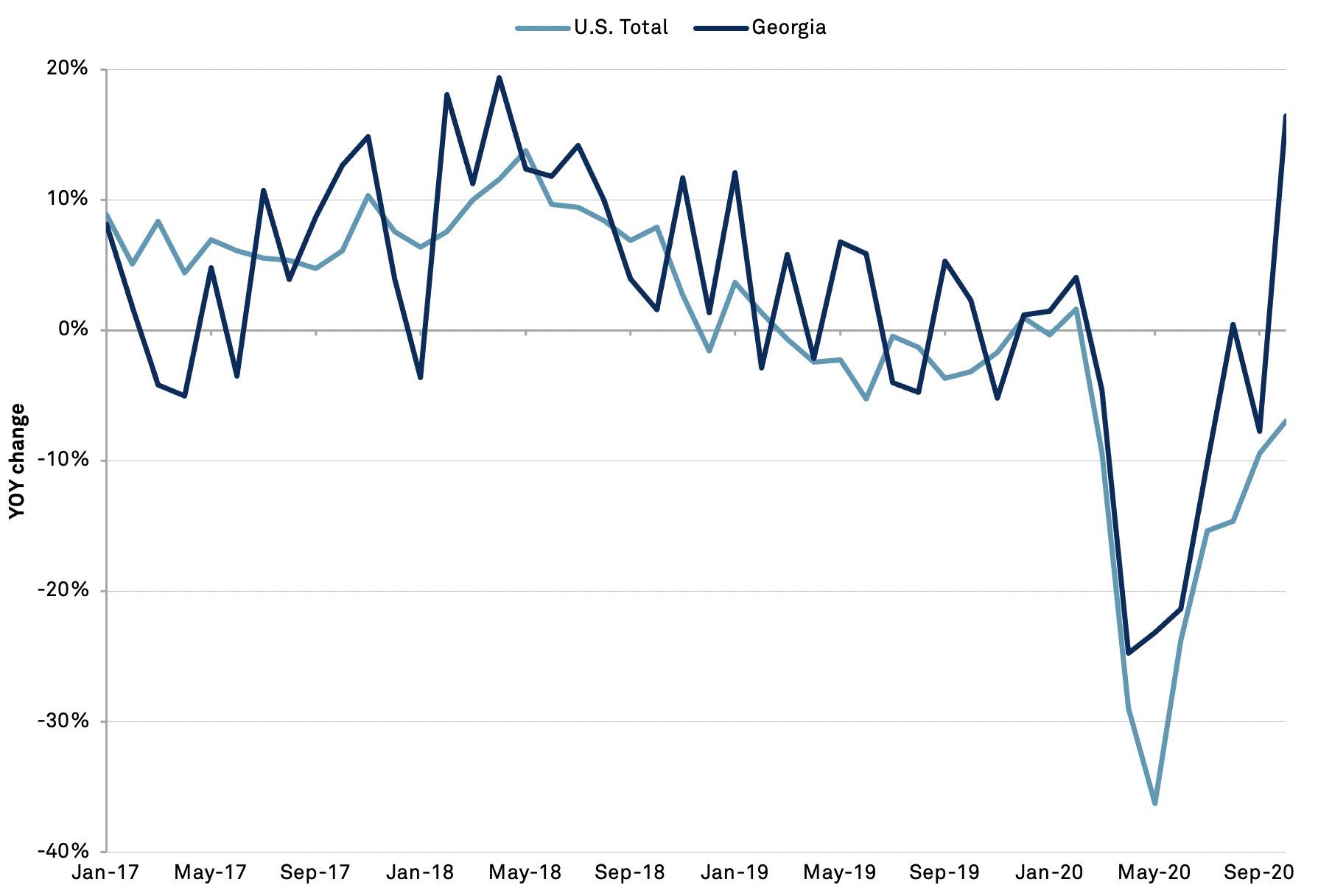
Panjiva’s analysis shows that Georgia has performed significantly better than the country at large in terms of exports with growth of 8.6% in the 12 months to Oct. 31 compared to 2016 while the national average was a 0.5% downturn. That’s been repeated in the shorter term with exports from Georgia up by 2.8% in the past three months while shipments from the U.S. in total fell by 12.2%.
Source: Panjiva
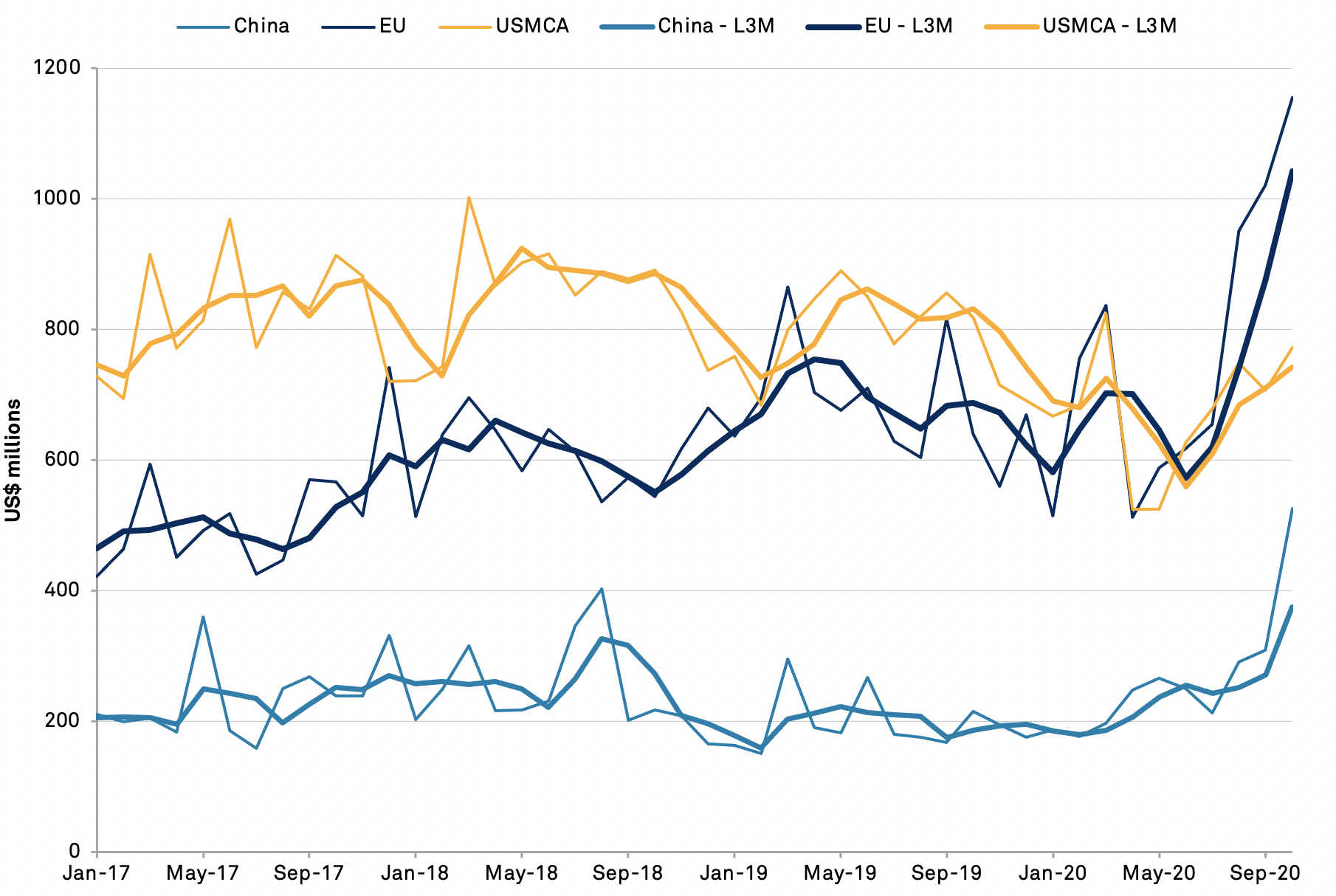
When compared to the national average Georgia’s exports are more exposed to the EU than average with 22.8% of the total in the past 12 months compared to 16.4% for the nation at large. Similarly it has a lower than average exports (21.1% versus 32.5%) to Mexico and Canada.
While that would suggest the importance of a need to rebuild relations with the EU, which have been damaged by spats over aerospace and metals, there’s nonetheless been a strong recovery in exports to the EU. Shipments to the EU rose by 51.6% year over year in the past three months due to a resumption of exports of passenger vehicles by Daimler’s Mercedes Benz, Panjiva’s data shows.
Georgia’s also benefited from the phase 1 trade deal negotiated by the Trump administration. Total exports to China from the state rose by 100.9% year over year in the three months to Oct. 31. That resulted in a 17.8% increase in the past 12 months compared to 2016 while the national average included a 0.7% reduction.
Source: Panjiva
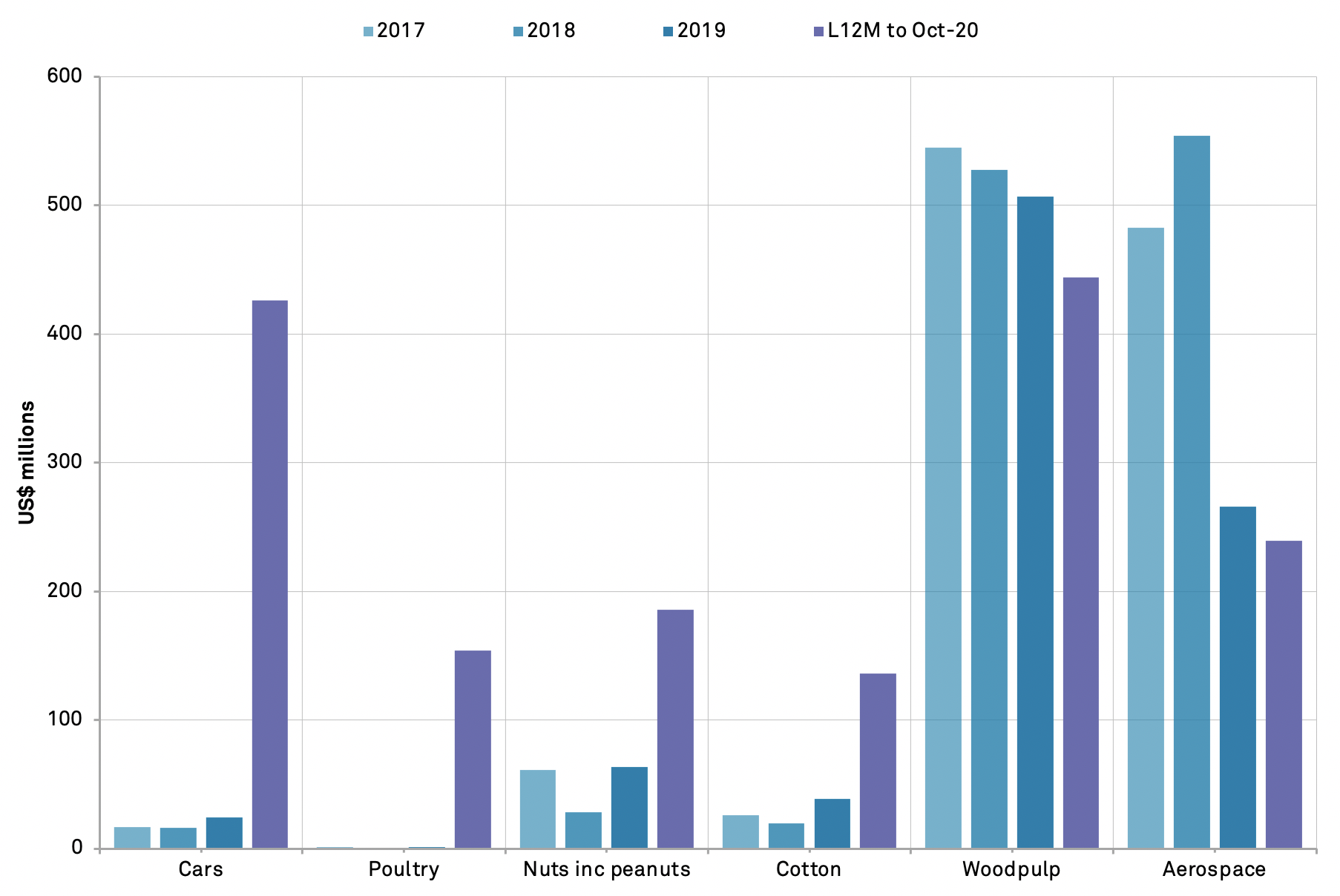
The rapid expansion of automotive exports has also been core to the recovery of exports from Georgia to China with $420 million of shipments in the three months to Oct. 31 compared to just $4 million a year earlier. The other main contributors have been a surge in exports of poultry, including shipments by Intervision Foods, to reach $67 million in the three months to Oct. 31 versus near zero both a year earlier and in 2017.
There’ve been similar surges in exports of other agricultural products including nuts (peanuts) which climbed 113% year over year and by 204% in the past 12 months versus 2017 as well as increased shipments of cotton. Two industries that have been materially worse off are wood pulp and aerospace. The former has likely suffered a drag from tariffs while aerospace likely reflects the impact of the pandemic on Gulfstream’s sales than the trade war per se.
Source: Panjiva