Es
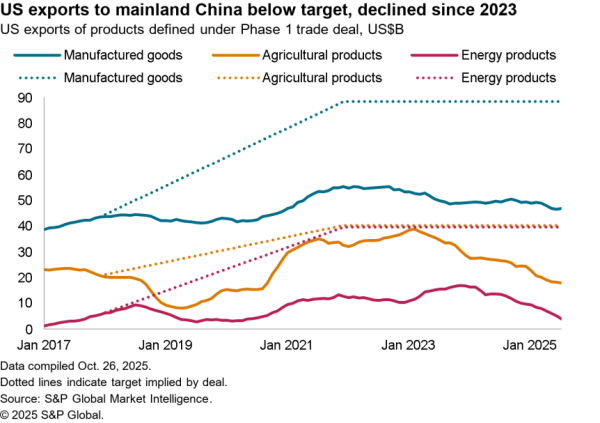
EsThe U.S. Trade Representative may launch another section 301 review of Chinese commercial practices, focusing on labor rights such as the right to organize and safety standards, Inside Trade reports. That follows the Trump administration’s section 301 review of intellectual property rights which, as shown in Panjiva research of Oct. 30, formed the legal back for the Trump administration’s tariffs on Chinese exports. That process has already led to duties on $250 billion of Chinese exports focused on electronics and capital goods.
While President Trump has repeatedly threatened to apply duties to all Chinese exports there may be concerns that this over-stretches the purpose of the original section 301 review. A new review based on labor rights would provide a more solid grounding for duties on labor-intensive industries. That would capture industries including apparel, the textiles value chain, leather products (such as luggage) and footwear, based on World Bank estimates of labor intensity.
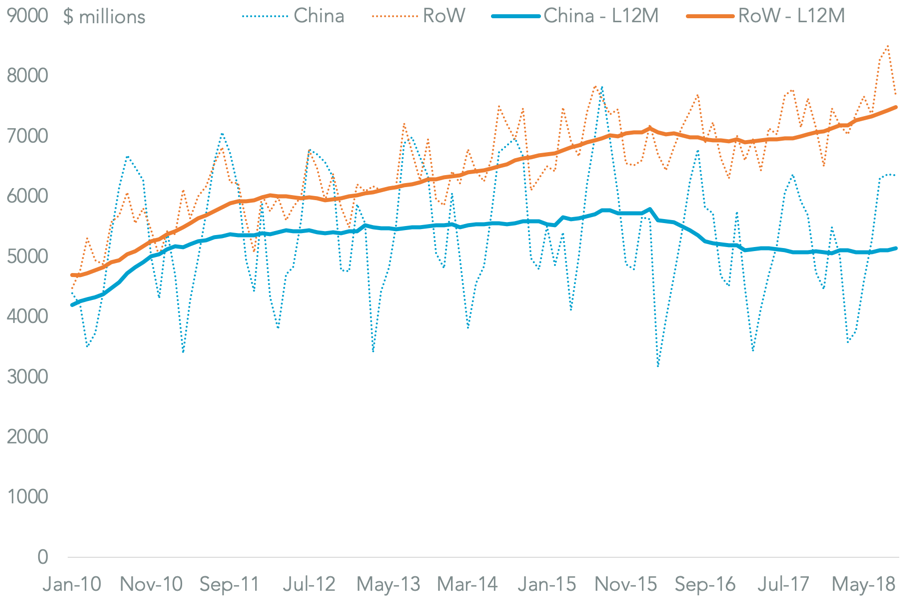
Panjiva data shows that Chinese exports of those four categories were worth $61.6 billion in the 12 months to Sept. 30, or 11.5% of total Chinese exports to the U.S.
There has been a decline with a 3.8% decline annually over the past three years as manufacturers switch out of China to other Asian states, though China still accounted for 40.7% of total U.S. imports of the four categories.
Source: Panjiva
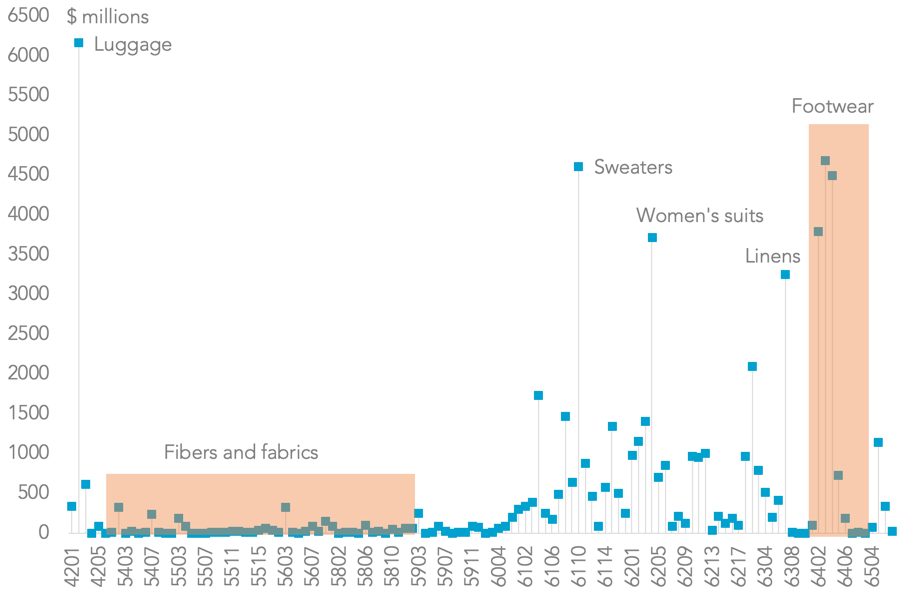
The practice in the IP-related section 301 review was to target very specific products first with higher duties and then become less discerning at lower rates after. Panjiva analysis shows that, in that regard the largest import lines in the 12 months to Sept. 30 were: handbags and luggage worth $6.16 billion, which are already covered by 10% duties under the previous review; sneakers worth $4.69 billion; and sweaters worth $4.61 billion.
Source: Panjiva
American apparel and footwear retailers are already preparing for the potential of rising duties, many already face duties of 10% on imports of luggage including handbags. Ralph Lauren CEO CEO Patrice Louvet has stated the firm is “continuing to diversify our supply chain to mitigate the long term impact of potential tariff scenarios.” Similarly Steve Madden CEO Edward Rosenfeld has indicated the company’s main response is to “aggressively shift production out of China”.
The leading retail importers of the four categories mentioned by sea since the start of 2017 include Target (2.1% of the total, or 58.8k TEUs), JC Penney (27.9k TEUs), Samsonite (15.7k TEUs), Skechers (13.3k TEUs) and WalMart (11.0k TEUs). However, there’s likely to be an impact on all retailers, potentially raising the risk that the import duties are passed through to consumers in what would effectively be a – potentially unpopular – regressive tax.

Source: Panjiva