Es
EsA military coup in Myanmar has seen the civilian government deposed after nearly 10 years of democracy, the Financial Times reports. There are three potential challenges for supply chains including: the impact of military action or political protests on economic activity; sanctions applied by other countries; and brand value issues for buyers of Myanmar’s exports.
Seaports remain open, according to Splash247, while the airport is reportedly closed. The position of regional partners for Myanmar is only just emerging, The position of regional partners for Myanmar is only just emerging. Panjiva’s data shows China represented 33.0% of Myanmar’s exports in 2019 while the EU represented 23.2%, Thailand 15.4%, Japan 7.4% and the U.S. 4.4%.
The Chinese government has stated it “hopes that all sides can resolve their differences“, South China Morning Post has reported.
The U.S. could have an outsize effect compared to its share of Myanmar’s exports, with sanctions given control over the dollar-denominated global payments system. The White House has already noted it will “will take action against those responsible“. Those may involve sanctioning individuals rather than the economy at large though the latter cannot be ruled out, given President Biden’s comments that “an immediate review of our sanction laws and authorities, followed by appropriate action” will be made. Targets could include oil supplies, Reuters reports. Relations were only normalized between the two countries in 2016 as discussed in Panjiva’s prior research.
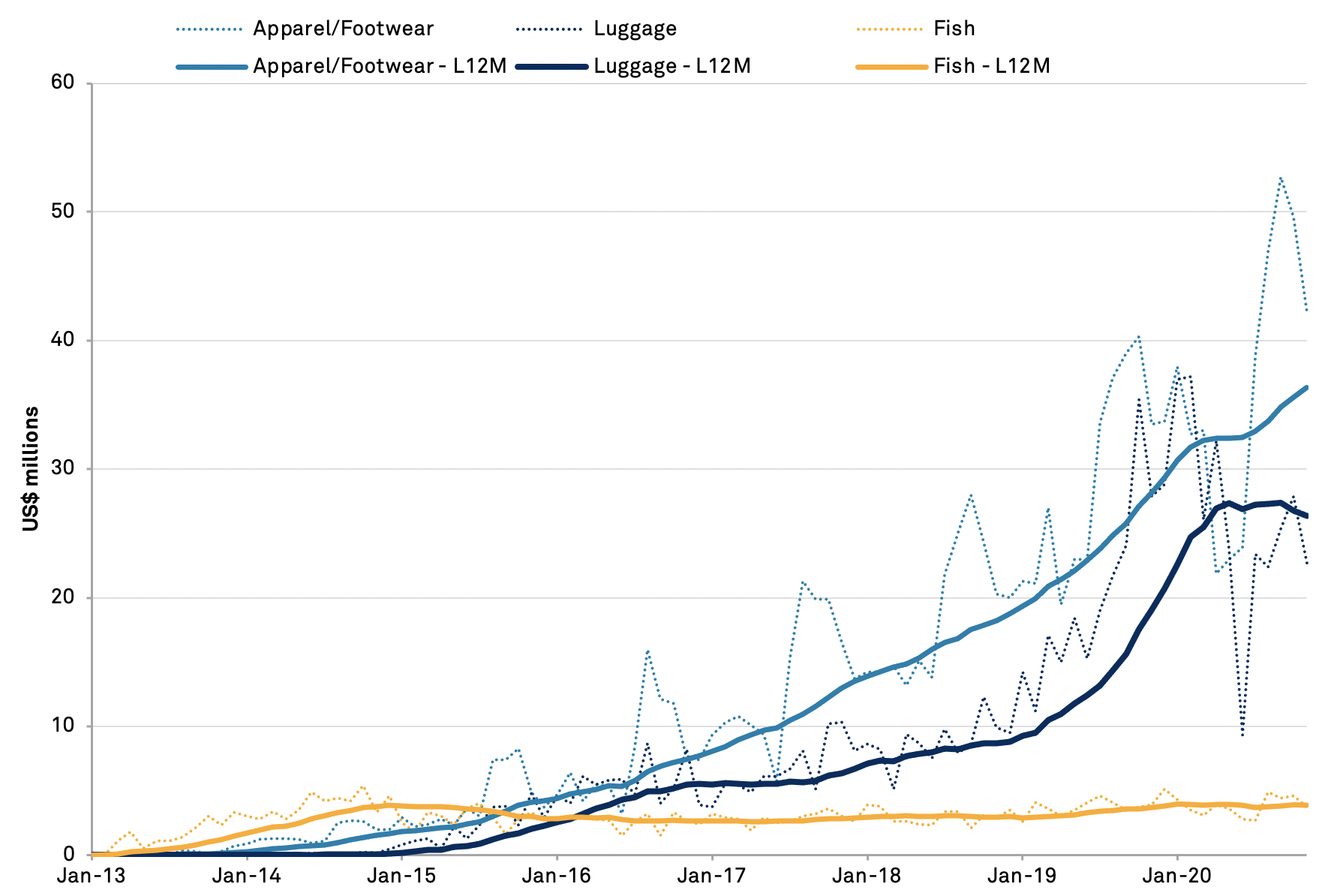
U.S imports from Myanmar reached $1.06 billion in the 12 months to Nov. 30 from $245 million in 2016. Sanctions do not need to be particularly sophisticated to be effective, with just three product lines represented three quarter of U.S. imports from Myanmar.
Apparel and footwear accounted for 41.4% of the total after increasing 4.7-fold in the 12 months to Nov. 30 compared to 2016. Imports of luggage meanwhile represented 29.9% of the total and also increased 4.7-fold. Third was fish with 4.4% of imports following more modest growth of 148%.
Source: Panjiva
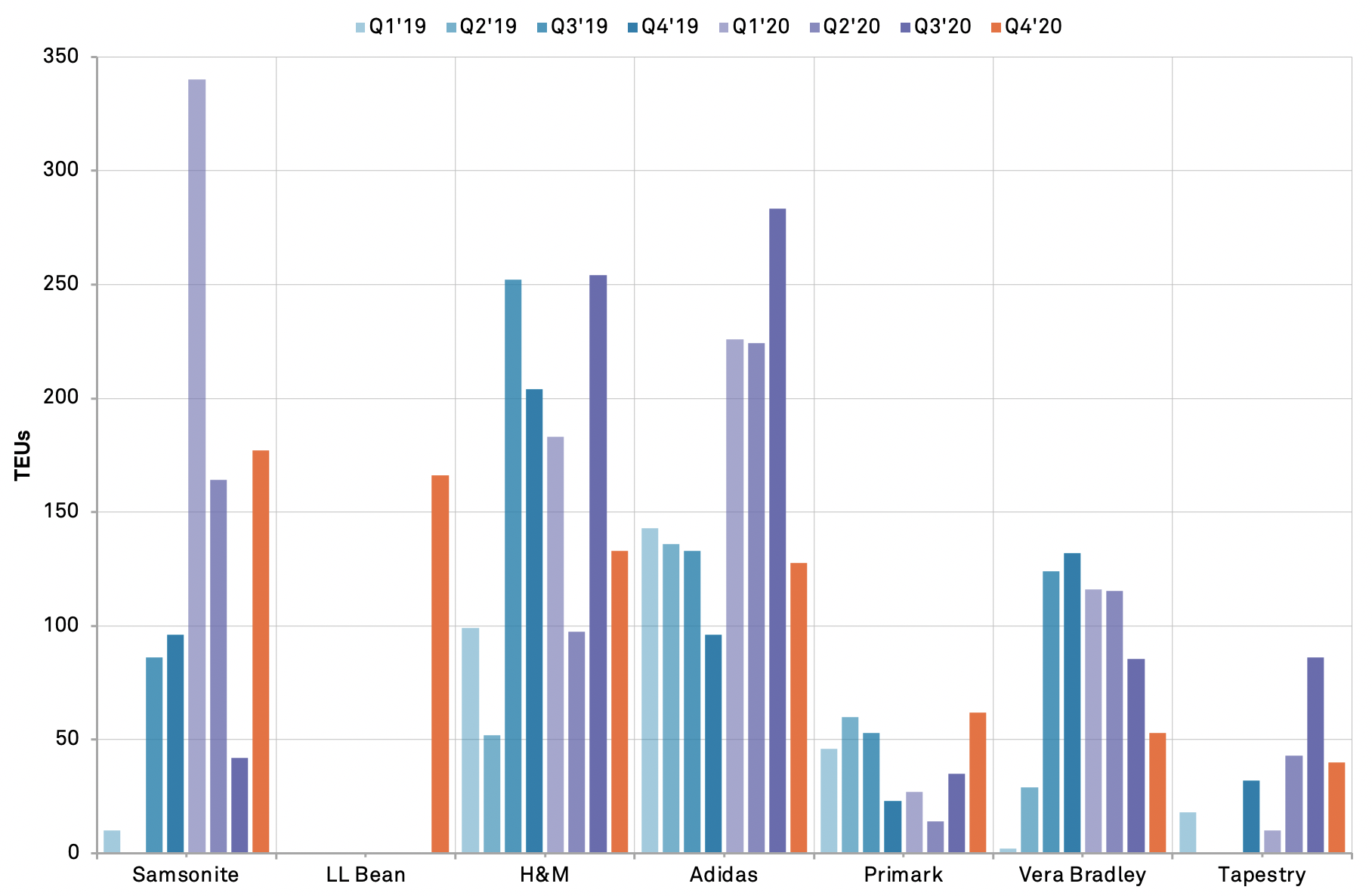
Panjiva’s data for U.S. seaborne imports indicates the largest importer of containerized freight to the U.S. from Myanmar in Q4’20 was luggage maker Samsonite, with 177 TEUs linked to the firm after growth of 84.5% year over year. Among the major apparel makers, privately owned LL Bean had 166 TEUs of imports linked to the firm, representing the first imports visible in Panjiva’s data since Q3’18.
Retailer H&M imported 133 TEUs after a decline of 34.8% compared to a year earlier while shipments linked to Adidas reached 128 TEUs after growth of 33.0%. Second tier apparel importers, by scale of shipments from Myanmar, included firms as diverse as Primark and Vera Bradley with 62 TEUs and 53 TEUs shipped respectively.
Source: Panjiva