Es
EsWe held a Panjiva Discussions webinar on January 22 to discuss our 2018 Outlook for global trade policy and the impact on corporate supply chains. The speakers were Panjiva’s CEO and co-founder Josh Green and Panjiva Research analyst, Chris Rogers. You can find all the research covered in the webinar on our dedicated 2018 Outlook page. Questions asked include: opportunities for development in India; the state of NAFTA negotiations; the potential winners from a NAFTA failure; and the future for the generalized system of preferences.
Q: India has taken more steps towards protectionism recently, should we still be optimistic about the development of its place in global trade in 2018?
The promise of the $700 billion Indian trade economy remains bright, as outlined in Panjiva research of September 21, though it has taken a step backwards recently. The government has implemented tariffs in both the up- and downstream parts of consumer electronics manufacturing as well as sugar and (potentially) solar. The government has an opportunity to correct this trend with forthcoming trade negotiations at the RCEP and BTIA trade deals with Asian and European countries respectively.
Nonetheless, an improvement shouldn’t be taken as a given as the government progresses with Prime Minister Modi’s “Make in India” policy. Panjiva data shows product-country combinations that might be under threat as this expands includes utility distribution components from Germany, PC components from China and electrical network components from Japan.

Source: Panjiva
Q: What are your thoughts about the NAFTA negotiations now, and what sectors should we be watching?
The sixth round of NAFTA negotiations that started on January 21 are a make-or-break round. Among the industrial sectors the biggest area of focus needs to be rules-of-origin in the automotive sector – it accounts for 69% of the U.S. trade deficit with Canada and Mexico and has proven the most contentious so far. However, from a political perspective agriculture may matter more given the importance of the farming community within President Trump’s “base” of voters ahead of the midterm elections.
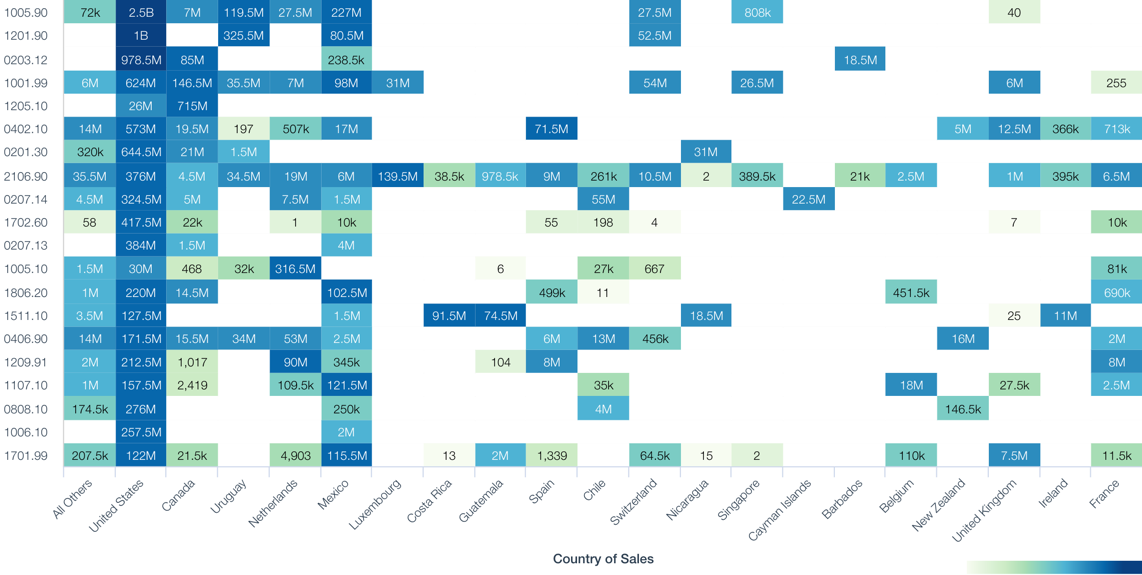
The critical issue will be to avoid retaliation from Mexico or Canada against U.S. exports in the event that either (a) negotiations fail or (b) the Trump administration chooses to withdraw from the deal. Major U.S. food export lines that Mexico may choose to diversify include corn ($2.38 billion of imports in the past 12 months to November 30), soybeans ($1.20 billion) and ham products ($979 million). Corn and soybeans are already also being supplied by Uruguay, while ham can also be supplied by Canada.
Source: Panjiva
Q: If the NAFTA negotiations fail and the U.S. quits the agreement, who are the potential winners in terms of companies or countries?
If tariffs are reinstated between the NAFTA countries, then manufacturers have two options – either onshore to each market in order to minimize transportation and tariff costs, or move out of the NAFTA region to take advantage of lower labor costs. The latter could work to the benefit of southeast Asian countries with low labor costs and rapidly growing manufacturing bases such as Vietnam. Vietnamese exports to the U.S. have grown by 15.2% annually for the past three years.
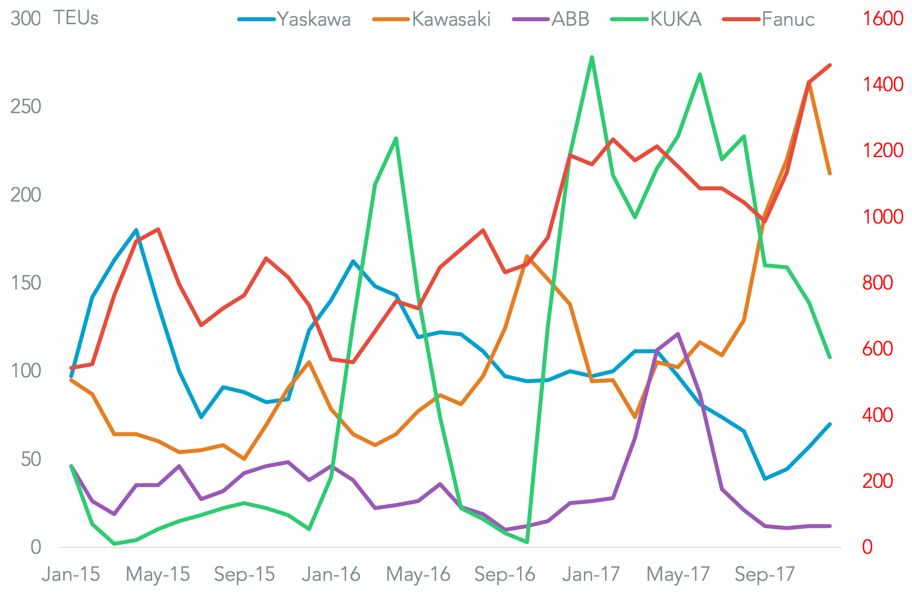
If manufacturers choose to move production out of Mexico and into the U.S. they may choose to increase their use of automation at the same time. That would generate new business opportunities for industrial robotics manufacturers. Leading exporters of robotics equipment to the U.S. include Fanuc, which has experienced a 22.8% rise in shipments in the fourth quarter, followed by Kawasaki Heavy and Yaskawa Heavy.
Source: Panjiva
Q: Will the Generalized System of Preferences be renewed?
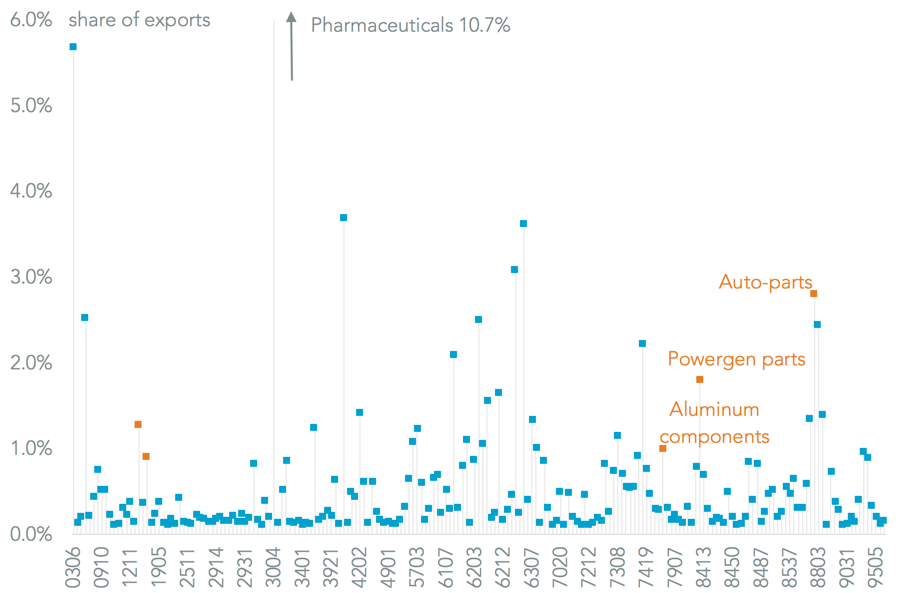
The GSP, which provides reduced tariffs on exports from developing economies to the U.S., has temporarily been suspended after it wasn’t renewed by the government at the end of 2017. It will likely be renewed, but will also receive a significant restructuring. One issue is that it includes several countries, including India, which have significant trade surpluses with the U.S. In the case of India that was $22.6 billion in the past 12 months, official data shows. One opition may be to remove India from the GSP altogether. A may be to exclude it from specific lines such as auto-parts (2.8% of Indian exports to the U.S. in the past 12 months), power generation equipment (1.8%) and aluminum components (1.0%).
Also worth watching is progress on the Miscellaneous Tariff Bill. This cuts tariffs for products at the specific request of American manufacturers. That covered 1,700 products in the recently passed House version of the bill, but still has to clear Senate and Presidential passage.
Source: Panjiva