Es
EsAs widely trailed President Donald Trump has ordered the U.S. Trade Representative to consider whether to bring a “section 301” investigation into Chinese trade policies regarding intellectual property. While this has an air of “talks about talks” it is a requirement of the Trade Act of 1974, and takes the technical form of a “section 302” petition.
Under that rule the USTR has 45 days, i.e. September 28, to make a recommendation as to whether, and how, to proceed. From that point a regular trade case cycle can be followed. It is worth noting that the President has not called for an “expeditious” timetable, as he has done with other trade reviews as outlined in Panjiva research of April 27. That may partly reflect the need to balance trade policy vs. China with other geopolitical considerations – as recently occurred with the North Korea sanctions situation.
It is likely that the USTR will recommend proceeding to a full case, given it recently published a report into precisely this topic, including China on its watchlist.
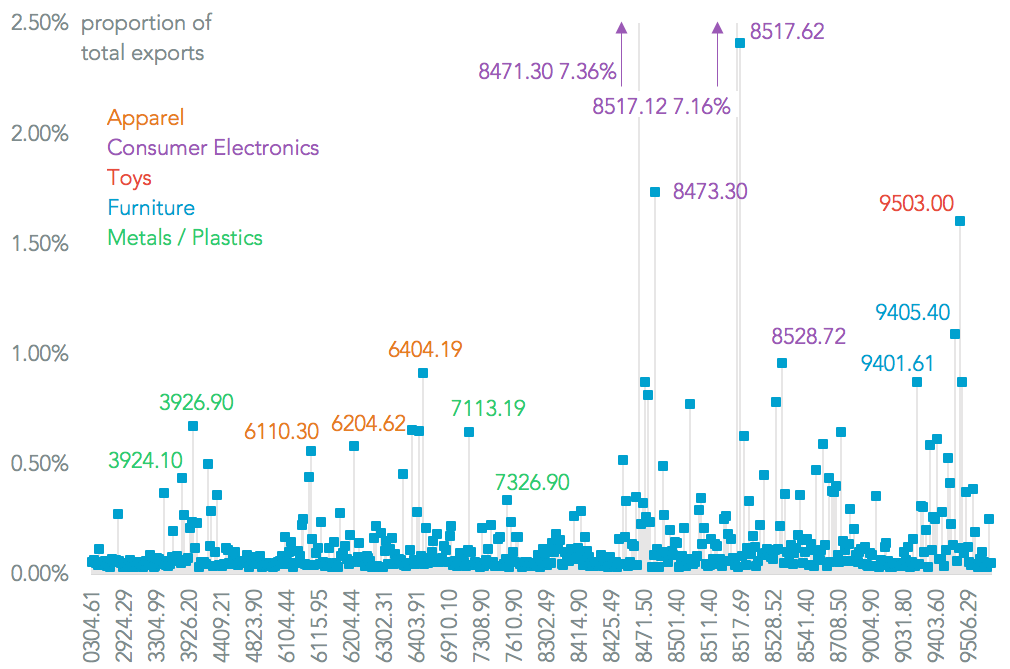
Assuming a case is pursued, and assuming it find trade policy actions – in the form of broad tariffs – should be made it is nonetheless difficult to find easy, significant export lines that could be actioned upon. Panjiva analysis of the top 500 export lines from China to the U.S., are heavily skewed towards consumer goods, with actions potentially coming just ahead of the traditional holiday shopping season.
Key lines include electronics (phones and computers equivalent to 20.5% of exports in the past year), apparel (11.7% including footwear and leather goods), furniture (7.0%) and toys (3.8%). Limiting imports – either through tariffs or quotas – would raise costs for retail consumers, cutting effective incomes.
Source: Panjiva