Es
EsThe U.S. and Brazil are progressing in trade talks with the goal of a broader bilateral agreement, Inside Trade reports. The agreement has not been drafted yet according to Foreign Affairs Minister Ernesto Araújo, who stated, “We are designing what I think is a very interesting package in the area of trade following the guidance of our presidents who want to build towards a meaningful and robust trade deal between us.”
This comes as Brazil has failed to capitalize on the U.S. China trade war. As noted in Panjiva research of Sept. 6 Brazilian soybean farmers had not been able to find additional business in China. The Brazilian government may therefore be looking to boost exports through other routes.
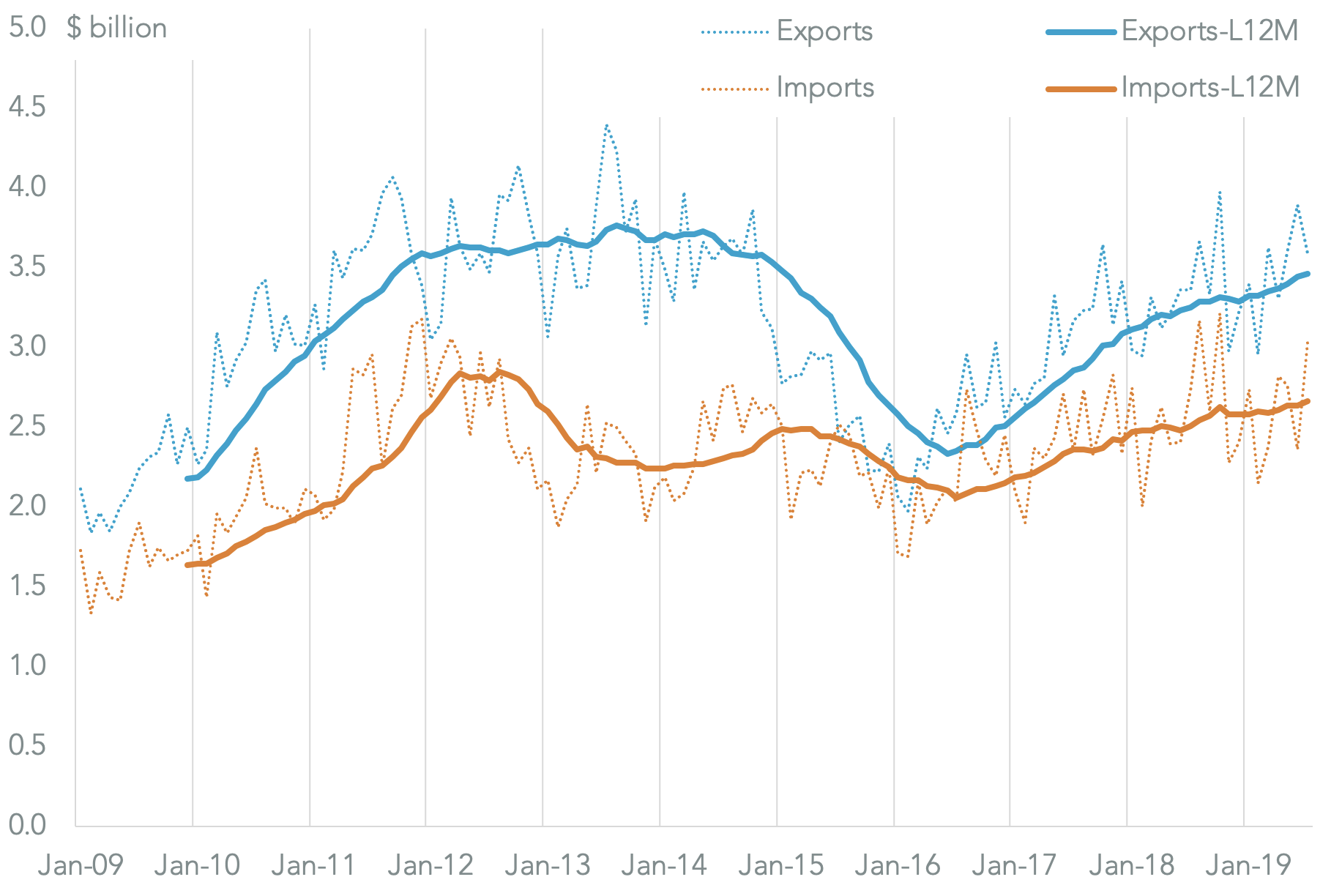
Panjiva data shows that U.S imports from Brazil have increased by 6.0% year over year on a twelve month average basis to Jul 31, to reach $31.9 billion. Exports to Brazil meanwhile climbed 6.6% to reach $41.6 billion. The resulting trade surplus will be seen as a positive by the Trump administration, who may want to solidify the gains made since a dip in the surplus in 2016. It may also help find new markets for goods displaced by the trade war with China.
The motivation for Brazil may be to reduce its reliance on the Mercosur region. Concerns there are highlighted by President Jair Bolsonaro’s threat, according to Bloomberg, to leave Mercosur if a left wing party comes to power in Argentina.
Yet, Brazil stands to lose significant tariff income on a relative basis should a deal proceed. In 2018, Brazil collected an estimated $2.3 billion in tariffs from the U.S., compared to $481 million earned by the U.S. on imports from Brazil.
Source: Panjiva
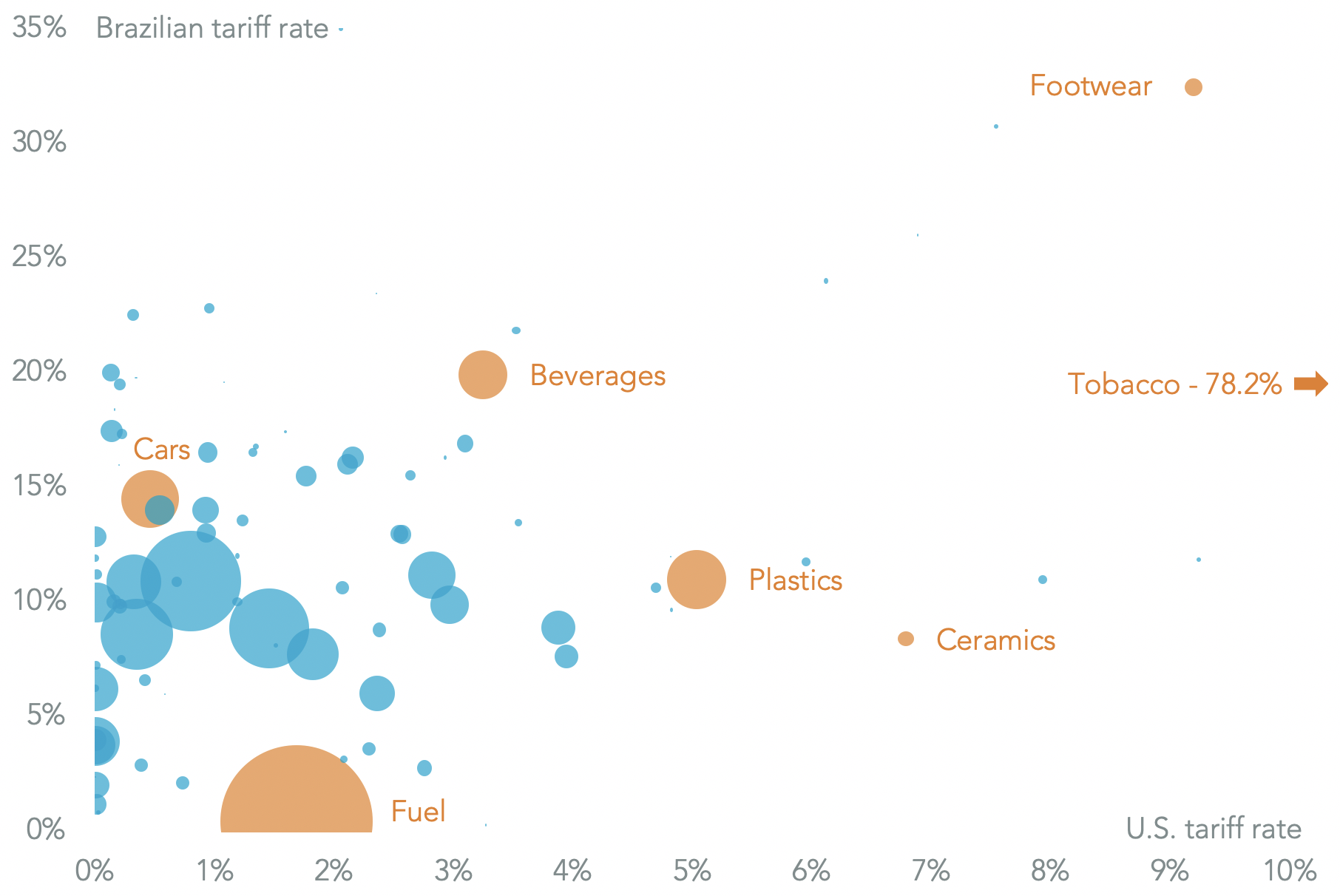
Trade negotiations are likely to focus on products with high tariff barriers. Panjiva analysis of aggregate tariff rates on products with over $100 million dollars in imports or exports show products where there may be an opportunity to promote increased shipments through reduced protectionism.
For U.S. exporters the greatest opportunities appear to be in beverages, cars, and plastics. The Trump administration’s negotiation with South Korea focused on improving access for U.S. automakers. U.S. exports of cars to Brazil totaled $1.1 billion in 2018, with an aggregate tariff rate of 14.5%.
Similarly, exports of plastics from the U.S. add up to $1.8 billion in the same period, with a tariff of 11.0%. In the beverage industry, exports reached $859 million dollars of goods to Brazil with a 19.9% tariff rate applied.
The opportunity for Brazilian exporters to find economic benefit from a trade deal are more limited. The export line with the highest tariff barrier is tobacco, with $212 million dollars imported to the U.S. in 2018. The aggregate 78.2% tariff rate would be a prime target for Brazilian negotiators, but any new trade deal increasing competition to U.S. farmers may prove politically contentious – particularly against the backdrop of the impact of the U.S.-China trade war.
Other export industries that ship to the U.S. that could benefit from lower trade barriers are footwear – valued at $194 million dollars and facing a 9.2% tariff – as well as ceramic products, with an aggregate 6.8% tariff applied on $133 million in U.S. imports.
Source: Panjiva
Panjiva data, retrieved via S&P Global Xpressfeed, for the tobacco sector shows R.J. Reynolds, a subsidiary of British American Tobacco, and Universal Leaf, saw declines in U.S. seaborne import volume of 52.7% and 38.9% year over year in the three months to Aug 31 respectively.
That decline may be due to fundamental weakness in the tobacco market. Universal’s Treasurer, Candace Formacek stated in the most recent earnings call that “Crop purchases are almost complete in Brazil and well underway in Africa,” as well as noting that Universal anticipates an increase in supply along side weakening demand for tobacco.

Source: Panjiva
Footwear companies Alpargatas and Steve Madden also saw a decline in imports of 14.6% and 14.3% respectively over the same period. Steve Madden may be focused more on Asia, with CEO Edward Rosenfeld have said on the firm’s Jul. 30 call that it is “moving production out of China primarily to Cambodia; and two, receiving price concessions from our factories on goods that remained in China”.

Source: Panjiva
Replicating the company search in S&P Global Xpressfeed
Replicating the company search is a good example of stitching together import and export datasets to analyze the relationship between two countries. A standard hs code enhanced U.S. search is used, with the addition of a ‘direction’ or ‘dir’ field to identify which side of the trading relationship it came from. The import and export searches are unioned together, and additional filters, in this case for hs codes 64, 24, and 73 are added.