Es
EsFollowing the start of Britain’s transitional exit period from the EU, the two sides have laid out their objectives for post Brexit trade and other relations for 2021 and beyond.
The European Commission has published a proposed negotiating text in the form of a 167 paragraph legal text that needs approval from member states, starting with the European Council of national leaders later this month. The text calls for a multi-part deal including trade in goods, customs cooperation, services, regulations, investment rules, fisheries, transportation and mobility of citizens.
Critically it includes references to a level playing field in standards. Importantly it includes the statement that the U.K. will not be “not subject to the same obligations as a member, cannot have the same rights and enjoy the same benefits as a member“.
The British government meanwhile has published a 29 paragraph statement of intent, though that reportedly is based on a deeper set of positions that have not yet been published to Parliament. The document specifically refers to signing a similar deal to that which the EU has signed with Canada (CETA) as a model. The British position refers to specific industries including organic products (i.e. agriculture and good), motor vehicles, chemicals and pharmaceuticals.
The temptation on the British side to follow a cookie-cutter approach is clear given the narrow time frame for signing a deal, as outlined in Panjiva research Jan. 31. In that regard it is worth noting that CETA is only provisionally in force and has only been ratified by 14 member states. At the latter stages of negotiations the process was actually held up by the regional parliament in Belgium.
CETA is not a truly free trade deal. While it cuts almost all tariffs that excludes a swathe of agriculture including dairy and meat. It also retains quotas in commodities though it does increase them. The deal also includes little provision for trade in services – vital for EU-U.K. trade – outside of government procurement contracts and elements of finance.
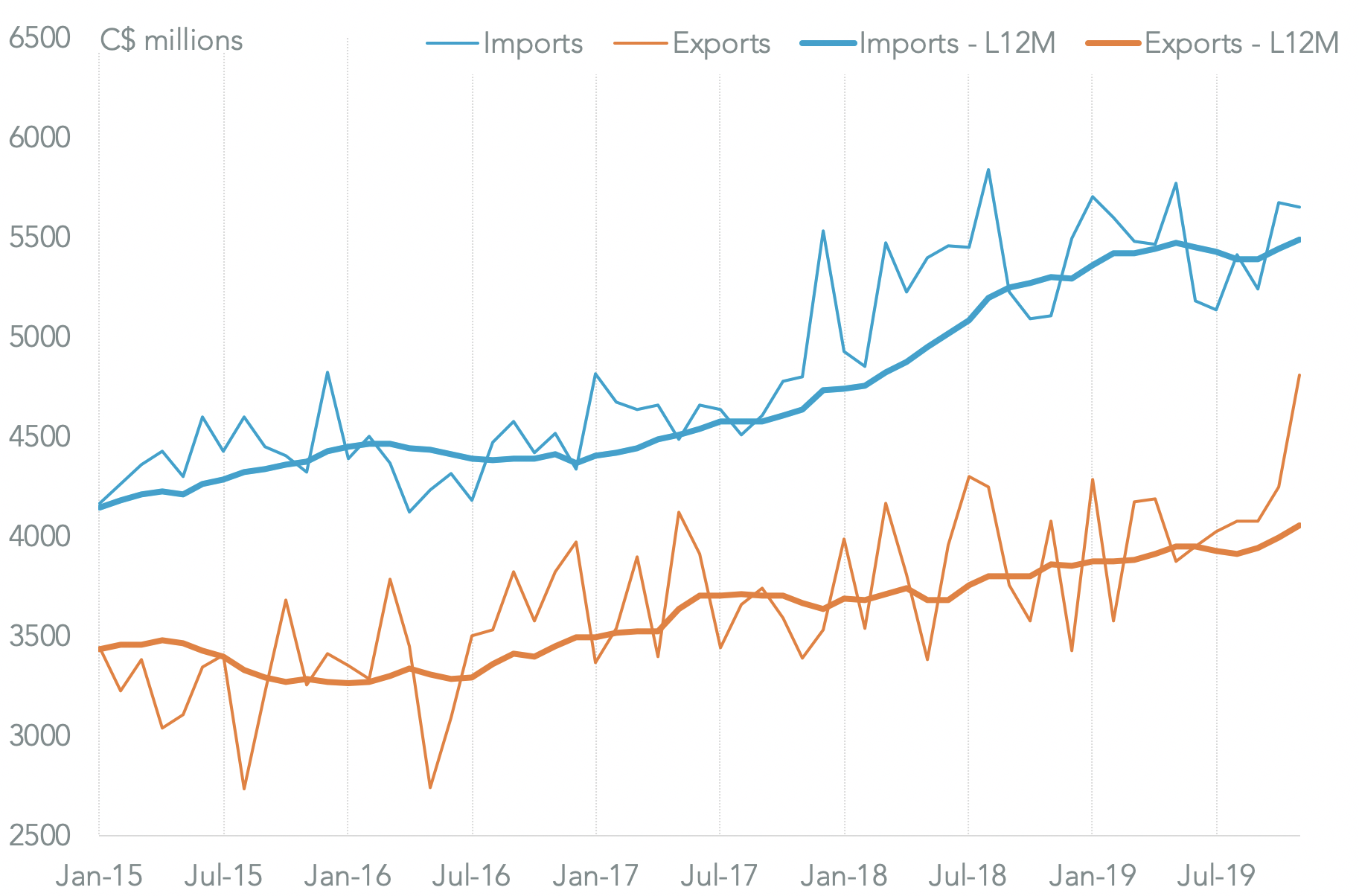
That said, there has been a positive impact on Canada’s trade with the EU since CETA came into force in Sept. 2017. Panjiva’s analysis of StatCan data shows Canada’s exports to the EU rose by 16.1% in the 12 months to Nov. 30 compared to calendar 2017 compared to 13.6% for its global exports. There’s been a bigger benefit for the EU though given Canada’s imports rose 25.5% over the same period compared to a 12.4% rise in its total imports.
Source: Panjiva
The economic situation between Canada and the EU is fundamentally different to that between the U.K. and EU. For example the EU still only accounts for 10.7% of Canadian imports in the 12 months to Nov. 30 and 8.2% of its exports. As a result the stakes in negotiations were much lower. By contrast the EU represented 52.8% of British exports and 47.2% of exports over the same period, Panjiva’s analysis of ONS data shows.
A closer analog may therefore be the U.S.-Mexico-Canada Agreement negotiations ( USMCA) where Canada was effectively a “rule taker” in terms of trade policy rules, in particular for rules of origin in the automotive sector. It should also be noted that, from a timing perspective, it still took from an initial kickoff of negotiations on Aug. 17, 2017 until Oct. 1, 2018 for a deal to be signed on the basis of the existing NAFTA rules. Even now however it has only just been ratified by the U.S. and is still proceeding through the Canadian Parliament.
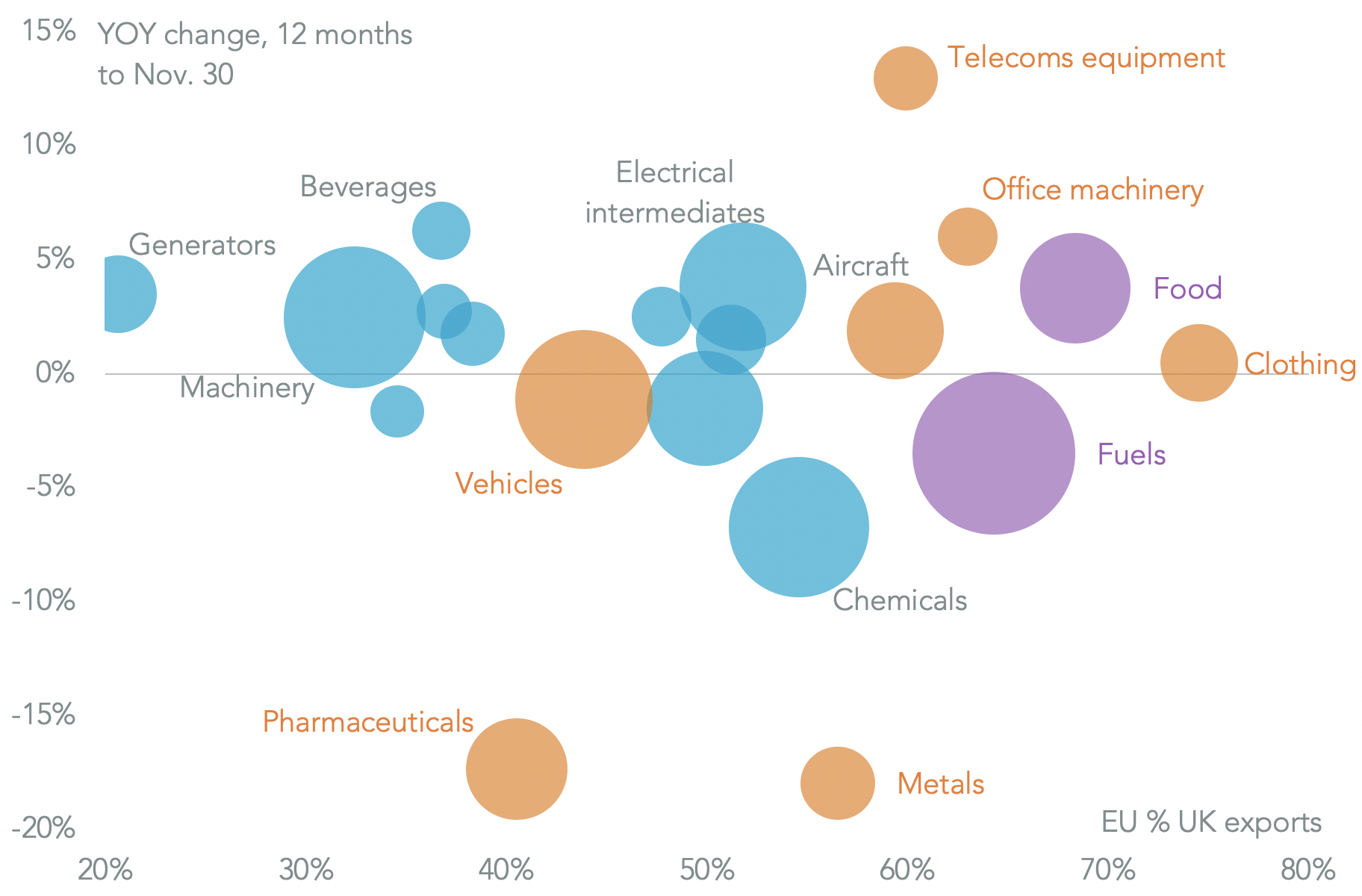
The autos sector also matters for EU-U.S. deals – it represents 10.2% of total U.K. exports to the EU while the EU represents 43.9% of U.K. automotive exports, Panjiva analysis of ONS data shows.
The most exposed sectors are clothing where the EU represented 74.5% of U.K. exports as well as food where the EU accounted for 68.4%. The largest sector – on a SITC basis – is fuel which accounts for 13.9% of British exports and the EU represents 64.3% of U.K. fuel shipments. That sector is likely to continue to be free of duties given the strategic nature of power, gas and oil trade between the two.
Among higher tech products the EU represented 63.0% and 59.9% respectively of U.K. exports of office machinery and telecoms equipment. In aerospace the ratio was 59.4%, relating mostly to Airbus’s cross-border, integrated supply chain which is unlikely to change.
There are several industries where exports are in decline and may need a boost from the trade deal. The EU represented 56.5% of EU exports of metals (both ferrous and non-ferrous) where shipments from the U.K. have fallen by 17.9% year over year in the 12 months to Nov. 30. Similarly exports of pharmaceuticals to the EU have fallen by 17.3%, though the EU only represents 40.5% of shipments.
Source: Panjiva